
Our Disciplic Succession: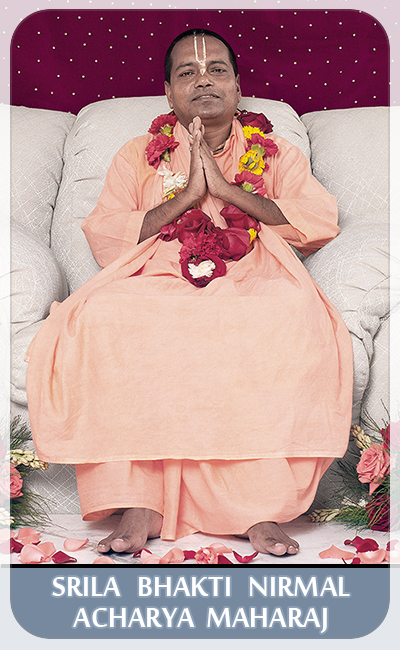


|
"The Sun Never Sets on Sri Chaitanya Saraswat Math":
|
| ABOUT US | GUIDANCE | LIBRARY | DAILY PRACTICE | PHOTO | CALENDAR | CONTACT | বাংলা |
(7/13) Mahaprabhu's Gift
His Divine Grace Om Vishnupad
Srila Bhakti Nirmal Acharya Maharaj
Singur (West Bengal), 5 February 2021, part 7
Translated from Bengali
শ্রীকৃষ্ণচৈতন্য প্রভু জীবে দয়া করি’ ।
স্বপার্ষদ স্বীয় ধাম সহ অবতরি ॥
sri-krsna-chaitanya prabhu jive daya kari’
svaparsada sviya dhama saha avatari
‘Bestowing mercy on jiva souls, Sri Krishna Chaitanya Mahaprabhu descends with His associates and abode.’
অত্যন্ত দুর্ল্লভ প্রম করিবারে দান ।
শিখায় শরণাগতি ভকতের প্রাণ ॥
atyanta durlabha prema karibare dana
sikhaya saranagati bhakatera prana
‘To distribute the rarest form of divine love, He teaches surrender, which is the life and soul of devotees.’
(Saranagati, Srila Bhaktivinod Thakur)
What does it say here? ‘Sri Krsna Chaitanya Prabhu jive daya kari.’ Who is Sri Krishna Chaitanya? Mahaprabhu. When Mahaprabhu took sannyas, His Name became Sri Krishna Chaitanya because He is Krishna who comes to this world to awaken the consciousness (chetan) of all living souls. Out of mercy to the souls, He comes to this world along with His associates (sva-parsada). All the Vraja gopis with whom He performs His pastimes in Dvapar-yuga come again together with the Lord in this Kali-yuga. Advaita Prabhu, Haridas Thakur, Nityananda Prabhu, Gadadhar Pandit – they all come in this Kali-yuga as the Lord’s associates. What do they come for? ‘Atyanta durlabha prema’ – they come to distribute the rarest divine love that nobody can ever attain. Brahma, Siva and many other exalted personalities always think, ‘When will I get this Krishna-prema?’ They always cry for this Krishna-prema, they always call out to the Lord, ‘O Lord, when will I get Your pure divine love?’ Mahaprabhu comes to this world and personally goes door to door distributing this very Krishna-prema to everyone.
Somebody can ask, ‘Why is Radharani’s Name not mentioned anywhere in Srimad Bhagavatam?’ Srimad Bhagavatam is not man-made, it is not written by anyone by pen or by anyone’s hand. Initially, Sukadev Goswami spoke it in front of Pariksit Maharaj; later, Suta Goswami, who was present during their conversation and heard it, spoke it again at Naimisaranya forest in front of sixty thousand rishis. This is how Bhagavatam appeared in this world. Nobody wrote it originally. Srimad Bhagavatam was spoken by Sukadev Goswami, a young boy of about sixteen years old. The book we all see now was later written by Srila Vedavyas, who recorded what had been spoken by Sukadev Goswami. That is why Lord Siva said, ‘Aham vedmi, Suka vetti, Vyasa vetti na vetti va. I know it, Sukadev knows it, and Vyasadev may or may not know it.’ Vyasadev gave such mercy to Sukadev that Sukadev could know everything, even that which Vyasadev himself may or may not have known. Sivji Maharaj’s words are very beautiful. So, why is there no mention of Srimati Radharani’s Name anywhere in Srimad Bhagavatam? For example, Srimad Bhagavatam contains an extensive description of Sri Prahlad Maharaj’s devotion. We know that his devotion is very high, but the devotion of Srimati Radharani is much higher than his, so why is Her Name not mentioned? The answer to this question is this. Sukadev Goswami felt, ‘I cannot preach it in this world. I cannot speak in front of everybody about that highest transcendental mood of Srimati Radharani. I cannot show it to the world.’ Her devotion is so much higher!
মাতল হরিজন কীর্ত্তন-রঙ্গে ।
পূজল রাগপথ গৌরব-ভঙ্গে ॥
matala hari-jana kirtana-range
pujala raga-patha gaurava-bhange
‘We will worship the path of raga-marga (spontaneous loving service) from afar and live in adherence to the Vedic rules and regulations.’
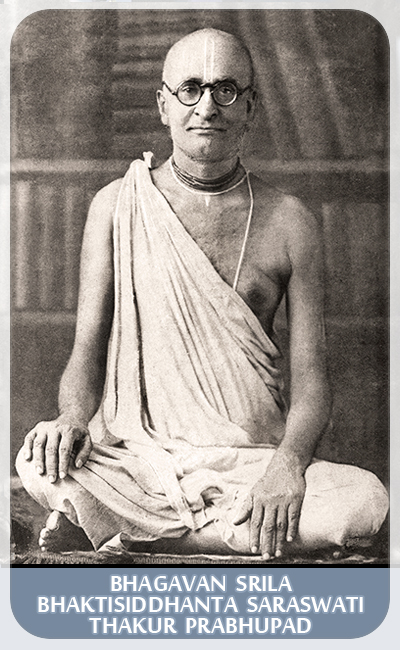
(Srila Bhaktisiddhanta Saraswati Thakur Prabhupad)
We must keep the raga-patha in our hearts; we will not show it in front of everyone. That is why Sukadev Goswami felt that he could not describe it to the whole world. Although Srimati Radharani’s devotion is so much higher, Sukadev Goswami neither described nor even mentioned it in Srimad Bhagavatam.
This great devotion that is found in Vraja should be the eternal object of our meditation. One time, Sri Chaitanya Mahaprabhu asked Ramananda Ray, ‘Among all kinds of mediation, which is the greatest?’ Ramananda Ray replied, ‘The highest meditation is the meditation on the holy lotus feet of Sri Sri Radha Krishna (meditation on the yugala-murti of Sri Radha and Sri Krishna).’ This is written in Sri Chaitanya-charitamrita. If you read it, you will find it there. It is also written there, ‘Who is the richest person?’ ‘One who is enriched with the wealth of Krishna is the richest person!’ In other words, one who has Krishna-prema is the richest person.
Sri Chaitanya Mahaprabhu roamed this land, going door to door, searching whom to give this very Krishna-prema: ‘Who wants to buy it? Who wants to take it?!’ He distributed this Krishna-prema to the whole world going door to door. Those who had some good fortune opened their doors, and those whose fortune was bad kept their door closed. What does ‘door’ mean? It is the doors of your hearts. You must open your hearts (hriday), your very beings (prana) – you must invite the Lord with your hearts and give Him a place to sit in your hearts.
Sri Vasu Ghosh wrote:
যদি গৌর না হ’ত, তবে কি হইত,
কেমনে ধরিতাম দে ।
রাধার মহিমা, প্রম-রসসীমা,
জগতে জানাত কে ? ॥
yadi gaura na ha’ta, tabe ki haita,
kemane dharitam de
radhara mahima, prema-rasa-sima,
jagate janata ke?
‘If Gaura had not come, what would have happened? How would we have lived? Who would have revealed to the world Radha’s glory and the acme of Her ecstatic divine love?’
(Sri Vasu Ghosh Thakur)
If Gauranga had not come, who would have known Srimati Radharani’s glory?
বরজ-যুবতী, ভাবের ভকতি,
শকতি হইত কার ?
varaja-yuvati, bhavera bhakati,
sakati haita kara?
‘Who would have shown the power of Vraja gopis’ ecstatic devotion?’
(Sri Vasu Ghosh Thakur)
‘Who would have been capable of revealing the ecstatic devotion of the young girls of Vraja if Gaura had not come?’ These are such beautiful words, written by Sri Vasu Ghosh.
This is the kind of gift Mahaprabhu descends to give together with His associates. Then, it says:
অত্যন্ত দুর্ল্লভ প্রম করিবারে দান ।
শিখায় শরণাগতি ভকতের প্রাণ ॥
atyanta durlabha prema karibare dana
sikhaya saranagati bhakatera prana
‘To distribute the rarest form of divine love, He teaches surrender, which is the life and soul of devotees.’
(Saranagati, Srila Bhaktivinod Thakur)
Mahaprabhu taught surrender. You can read Mahaprabhu’s Siksastakam and see the third and fourth verses, then you will understand what Mahaprabhu’s teachings are. The third verse is this:
তৃণাদপি সুনীচেন তরোরিব সহিষ্ণুনা ।
অমানিনা মানদেন কীর্ত্তনীয়ঃ সদা হরিঃ ॥
trnad api sunichena taror iva sahisnuna
amanina manadena kirtaniyah sada harih
‘One who is humbler than a blade of grass, more tolerant than a tree and who gives honour to others without desiring it for themselves is qualified to always chant the Holy Name of Krishna.’
(Sri Chaitanya-charitamrita, 3.6.239)
Be humbler than a blade of grass, more tolerant than a tree, and give honour to others. If you can be like this, then you will get the right to chant the Holy Name. It is necessary to earn the qualification, or right, to chant the Holy Name of the Lord.
শ্রীকৃষ্ণকীর্ত্তনে যদি মানস তোহার ।
পরম যতনে তঁহি লভ অধিকার ॥
তৃণাধিক হীন দীন অকিঞ্চন ছার ।
আপনে মানবি সদা ছাড়ি’ অহঙ্কার ॥
বৃক্ষসম ক্ষমাগুণ করবি সাধন ।
প্রতিহিংসা ত্যজি’ অন্যে করবি পালন ॥
জীবন-নির্ব্বাহে আনে উদ্বেগ না দিবে ।
পর-উপকারে নিজ সুখ পাসরিবে ॥
sri-krsna-kirtane yadi manasa tohara
parama yatane tanhi labha adhikara
trnadhika hina dina akinchana chhara
apane manabi sada chhadi’ ahankara
vrksa-sama ksama-guna karabi sadhana
pratihimsa tyaji’ anye karabi palana
jivana-nirvahe ane udvega na dibe
para-upakare nija sukha pasaribe
‘If you are determined to chant the Name of Krishna, then strive as hard as you can to attain the qualification for that. You must always leave ego and consider yourself to be more lowly than a blade of grass, poor, destitute and wretched. You must practise tolerance like that of a tree and nurture others giving up vengeance. You must live without causing anxiety to others and do good unto others forsaking your own happiness.’
(Sri Gitavali, Sri Siksastaka Giti, Srila Bhaktivinod Thakur)
You must give up your own happiness for the sake of others’ happiness. Be humbler than a blade of grass, more tolerant than a tree and give honour to others. ‘Vrksa-sama ksama-guna’ means you must be forgiving (ksama). If somebody makes an offence and you cannot forgive the person, then what kind of a Vaishnav are you? When you cut a tree, it does not turn its face away from you – it still gives you shelter in its shade. You can cut a tree’s branch, but when the sun is very hot, you go to the other side of that same tree and take shelter by its trunk. When a tree can be this forgiving, we too must show this quality. ‘Pratihimsa tyaji anye karabi palana’: if somebody ill-treats you, does it mean that you will also ill-treat the person in return? No. You must give up all vengeance. If somebody is mean to you, if somebody swears or criticises you, it means they have a problem that is why they swear you – they have some difficulty, that is why they are criticising or being mean to you. Do you understand what I am saying?
This is the meaning of ‘sikhaya saranagati’. Mahaprabhu comes to teach us surrender. Surrender means being extremely humble, being tolerant and giving honour to others (treating others with respect). This is what Mahaprabhu taught. What does the other, fourth, verse of Mahaprabhu’s Siksastakam teachings say?
ন ধনং ন জনং ন সুন্দরীং কবিতাং বা জগদীশ কাময়ে ।
মম জন্মনি জন্মনীশ্বরে ভবতাদ্ভক্তিরহৈতুকী ত্বয়ি ॥
na dhanam na janam na sundarim kavitam va jagadisa kamaye
mama janmani janmanisvare bhavatad bhaktir ahaituki tvayi
‘O Supreme Lord (Master of the Universe, Jagadiswar)! I do not desire any wealth (religion, money or material desires), any followers (wife, sons, servants or maidservants) or material knowledge (beautiful poetry). My only prayer is that I may birth after birth have pure devotion to You, devoid of seeking any result.’
(Sri Chaitanya-charitamrita, 3.20.29)
People always pray, ‘Give me wealth’, ‘Give me knowledge’, ‘Make me beautiful’, ‘Give me a good wife’, ‘Make me a poet’, and so on. Mahaprabhu said, ‘No. I do not want any wealth. I do not want any followers. I do not want a beautiful wife. I do not want to be a poet. I do not want to live a lifetime of Brahma (Jagadish)!’
ধন জন আর, কবিতা সুন্দরী,
বলিব না চাহি দেহ-সুখকরী ।
জন্মে জন্মে দাও, ওহে গৌরহরি,
অহৈতুকী ভক্তি চরণে তোমার ॥
dhana jana ara, kavita-sundari,
baliba na chahi deha-sukha-kari
janme janme dao, ohe gaurahari,
ahaituki bhakti charane tomara
‘When will I say that I do not want any wealth, followers, poetic gift or any other bodily happiness? O Gaura Hari! Birth after birth, please give me unconditional devotion to Your holy feet!’
(Saranagati, Srila Bhaktivinod Thakur)
What do I want to have birth after birth? I only want unconditional devotion to Your holy lotus feet. I do not want any wealth!
নাহি মাগি দেহ-সুখ, বিদ্যা, ধন, জন ॥
নাহি মাগি স্বর্গ, আর মোক্ষ নাহি মাগি ।
না করি প্রার্থনা কোন বিভূতির লাগি’ ॥
nahi magi deha-sukha, vidya, dhana, jana
nahi magi svarga, ara moksa nahi magi
na kari prarthana kona vibhutira lagi’
‘O Lord! I am submitting this appeal at Your feet: I do not pray for any bodily pleasures, knowledge, wealth or companions. I do not pray for heaven or liberation, neither do I pray for any godly opulence or powers.’
(Sri Gitavali, Sri Siksastaka, Srila Bhaktivinod Thakur)
‘I do not want heaven, I do not want liberation.’ How beautiful Mahaprabhu’s teachings are!
দৈন্য, আত্মনিবেদন, গোপ্তৃত্বে বরণ ।
‘অবশ্য রক্ষিবে কৃষ্ণ’—বিশ্বাস পালন ॥
ভক্তি-অনুকূল মাত্র কার্য্যের স্বীকার ।
ভক্তি-প্রতিকূল ভাব-বর্জ্জনাঙ্গীকার ॥
ষড়ঙ্গ শরণাগতি হইবে যাঁহার ।
তাঁহার প্রার্থনা শুনে শ্রীনন্দকুমার ॥
dainya, atma-nivedana, goptrtve varana
‘avasya raksibe krsna’—visvasa palana
bhakti-anukula matra karyera svikara
bhakti-pratikula bhava—varjanangikara
sad-anga saranagati haibe yanhara
tanhara prarthana sune sri-nanda-kumara
‘(1) Humility, (2) self-submission, (3) accepting that the Lord is your maintainer, (4) keeping faith that “Krishna will certainly protect”, (5) engaging only in what is favourable to devotion, (6) rejecting what is unfavourable to devotion. Lord Krishna hears the prayers of those who surrender to Him in these six ways.’
রূপ-সনাতন-পদে দন্তে তৃণ করি’ ।
ভকতিবিনোদ পড়ে দুই পদ ধরি’ ॥
rupa-sanatana-pade dante trna kari’
bhakativinoda pade dui pada dhari’
‘With a straw between his teeth, Bhaktivinod falls before Rupa and Sanatan, clasping their feet.’
কাঁদিয়া কাঁদিয়া বলে, আমি ত’ অধম ।
শিখায়ে শরণাগতি করহে উত্তম ॥
kandiya kandiya bale, ami ta’ adhama
sikhaye saranagati karahe uttama
‘Crying bitterly, he prays, “I am a wretched soul! Please grant me the highest qualification by teaching me surrender.”’
(Saranagati, Srila Bhaktivinod Thakur)
It is said here that surrender consists of six aspects, or limbs (sad-anga saranagati). These six aspects are humility, self-submission, relying on the Lord (realising that Krishna is your maintainer and guardian), believing in the Lord’s protection, accepting only what is favourable to devotion and rejecting everything that is unfavourable to devotion.
Krishna is our maintainer. Krishna is our protector.
মারবি রাখবি—যো ইচ্ছা তোহারা ।
নিত্যদাস প্রতি তুয়া অধিকারা ॥
marabi rakhabi—yo ichchha tohara
nitya-dasa prati tuya adhikara
‘Whether You kill me or protect me, it is up to You. You have full right over Your eternal servant.’
(Saranagati, Srila Bhaktivinod Thakur)
If He wants, He can kill; and if He wants, He can save. Nobody else has the power to save us. If Krishna wants somebody to die, the person will die.
Also, we must always accept that which is favourable to devotion. Many people do what is favourable and at the same time also do what is unfavourable to devotion. This will not do. ‘Anukulyasya samkalpah, pratikulya vivarjjanam: accept what is favourable and reject what is unfavourable.’
We pray, ‘Chhaya vega dami’ chhaya dosa sodhi’ chhaya guna deha’ dase. O Vaishnav Thakur! Please subdue the six urges, rectify the six defects and please bestow the six good qualities upon this servant.’ The six urges are vakya-veg, jihva-veg, mano-veg, krodha-veg, udar-veg, upastha-veg (the urges of speech, tongue, mind, anger, stomach and genitals). We must always control these six urges because they are unfavourable to devotion. If you can control them, it is called bhakti-anukul (doing what is favourable to devotion), and if you cannot control them, then it is bhakti-pratikul (doing what is unfavourable to devotion).
Suppose you are doing a yajna. If you put one spoon of ghee and then one spoon of water, you cannot make a yajna like this. You must put only ghee; otherwise, if you put water into fire, the fire will go out. Therefore, if you do what is favourable to devotion but do not give up doing what is unfavourable, what result will you get? If you drink alcohol and milk, what will that give you? Alcohol will take away all the benefit of drinking milk. So, people think, ‘I will eat fish, meat, eggs, onion, garlic, and I will just chant the Holy Name.’ You can never chant the Holy Name like this. It may sound like the Hare Krishna maha-mantra, but ‘Nama aksara bahiraya bate tabu Nama kabhu naya. Externally, you pronounce the letters of the Holy Name, but it can never be the Holy Name proper’ (Sri Sri Prema-vivarta, 7.1). If you do what is unfavourable to devotion, then what you chant is merely the alphabet, the letters of the Name – it can never be the Holy Name proper.
অসাধুসঙ্গে ভাই কৃষ্ণনাম নাহি হয় ।
নামাক্ষর বাহিরায় বটে তবু নাম কভু নয় ॥
asadhu-sange bhai krsna-nama nahi haya
namaksara bahiraya bate tabu nama kabhu naya
‘Brother, the Name of Krishna cannot be chanted in bad association: it may certainly sound like the letters of the Name, but it can never be the Name proper.’
(Sri Sri Prema-vivarta, 7.1, Srila Jagadananda Pandit)
If you want to chant the Holy Name, then you must understand:
‘সাধুসঙ্গ’, ‘সাধুসঙ্গ’—সর্ব্বশাস্ত্রে কয় ।
লবমাত্র সাধুসঙ্গে সর্ব্বসিদ্ধি হয় ॥
‘sadhu-sanga’ ‘sadhu-sanga’—sarva sastre kaya
lava-matra sadhu-sange sarva-siddhi haya
‘All scriptures keep saying: “Good association”, “Good association.” You can attain all perfection even just by a drop of good, saintly association.’
(Sri Chaitanya-charitamrita, 2.22.54)
It is necessary to keep good, saintly association. Sadhus are those who practise Krishna consciousness, who serve the Lord with unswerving determination (nistha). Those who do not practise even one of the practices of Krishna consciousness (sravanam, kirtanam, smaranam, pada-sevanam, archanam, vandanam, dasyam, sakhyam, atma-nivedanam: listening about the Lord, chanting the Lord’s Name and glories, remembering the Lord, serving the Lord’s lotus feet, worshipping the Lord’s Deity, offering obeisances to the Lord, serving the Lord as a servitor, serving the Lord as a friend, submitting yourself to the Lord) are called ‘asat’ (inauspicious, unsaintly). ‘Asat’ means liars, thieves, free mixers (who illegally associate with women). Those who practise at least one of the devotional practices are called ‘sat’ (truthful, saintly, auspicious).
Remember this. Always do what is favourable to devotion and do not do what is unfavourable to devotion (always leave, give up what is unfavourable). We must not lie, we must not disrespect others, and we must avoid the association with those who gamble, drink alcohol, mix freely with women, who kill – such persons are ‘asat’. Always associate with those who are ‘sat’ – who practise at least one of the nine devotional practices.
— : • : —
| ◄ | ► |
{ 2001 |
2002 |
2003 |
2005 |
2009 |
2010 |
2011 |
2012 }
{ 2013 |
2014 |
2015 |
2016 |
2017 |
2018 |
2019 |
2020 |
2021 }
CLICK TO LISTEN TO THE LECTURE
Size: 52 Mb
Length: 108 min
Language: Bengali
READ OTHER PARTS:
1)
Honouring Hari-Prasad
2)
Exclusive Path
3)
Lord's Messenger
4)
'Managing' Your Life
5)
Internal Purity
6)
Pray To Be One-Pointed
7)
Mahaprabhu's Gift
8)
At Vaishnavs' Mercy
9)
Spiritual Deposit
10)
Lacking Spirituality
11)
About Srila Lochan Das
Thakur
12)
Leave Separate
Interests
13)
Muddled Minds
| A New Lease of Life |
|---|
| 'When you get association of a sadhu you understand that you have wasted all your time on maya. Maya has always been taking our time, and we have been always listening to her instruction, but now, by sadhu-sanga, we understand that we did wrong..' |
 |
“Atma, the soul,
is covered by Maya with the illusory environment, but through good association the soul can become open, can become clean, nirmal.” |
|
Sitemap | Contact us | About us