
Our Disciplic Succession:


|
"The Sun Never Sets on Sri Chaitanya Saraswat Math":
|
| ABOUT US | GUIDANCE | LIBRARY | DAILY PRACTICE | PHOTO | CALENDAR | CONTACT | বাংলা |
SRI NABADWIP DHAM MAHATMYA-MUKTA-MALA
Koladwip (Pada-sevanam: serving the lotus feet of the Lord)
Sri Vishnupriya Devi’s House:
Abode of Separation
Continuing Sri Nabadwip Dham parikrama, by the mercy of Sri Gurupadpadma, we have now come from the temples of Sri Vrddha Siva and Praudha Maya to this enchanting and extremely esoteric place: the house of Sri Vishnupriya Devi (people often call it ‘Mahaprabhu’s house’).
We can see in Sri Gaura-ganoddesa-dipika that Sri Vishnupriya Devi is Satyabhama in the Dvaraka pastimes of the Lord: she is an expansion of Srimati Radharani.
The name of Vishnupriya Devi’s father is Sri Sanatan Misra. Being a great Vaishnav and a brahman devoted to Lord Vishnu, he received a jewel of a daughter, who not only was extremely beautiful but also embodied all good qualities – he named her Sri Vishnupriya (‘dear to Vishnu’). From her childhood, Sri Vishnupriya Devi served Tulasi every day, engaged in Deity worship and other services to the Lord, and she would also go to the Ganges every day to take bath. Sometimes, she would meet Sachi Mata – every time Sri Vishnupriya Devi saw her, she offered her obeisances. Sachi Mata would also bless her every time, ‘May Krishna give you a worthy husband,’ thinking to herself, ‘May this girl marry my son.’
Mahaprabhu’s first spouse was Sri Laksmipriya Devi, but when Mahaprabhu went to Bangladesh to study, she was bitten by the snake of separation: not being able to tolerate separation from Mahaprabhu, she left her body and went to Mahaprabhu. After a while, Sri Sachi Mata went to Kasinath Pandit and requested him to arrange Nimai and Sri Vishnupriya Devi’s marriage. To please His mother, Nimai did not object. In this way He got married the second time. On the day of their marriage, all devotees were so extremely jubilant – I have no power to describe it! Entire Nabadwip was filled with joy on that day. Sri Vishnupriya Devi’s heart was also overjoyed: she had been very attracted to the Lord since her childhood, and now her innermost desire was finally fulfilled – she received the shelter and service to the Lord’s holy lotus feet.
Some time after His second marriage, Mahaprabhu went to Gaya Dham, and upon His return, everything changed. Even when He looked at Sri Vishnupriya Devi, He did not see her: overwhelmed with Krishna-prema, He only chanted the Holy Name of Lord Krishna. Nobody could understand anything. Everybody said that Nimai had gone mad. Seeing conditioned souls’ aversion to the Lord and deep attachment to the illusory environment, Mahaprabhu eventually decided to take sannyas (enter the renounced order of life). Before leaving home, He revealed His intention to Sri Sachi Mata and Vishnupriya Devi, and both were dumb-struck and could not say anything: Mahaprabhu is the Lord Himself, He is the independent Supreme Lord, so nobody could bind Him and force Him to stay.
There is a very intimate and painful conversation that Srila Vrindavan Das Thakur did not write about in his Sri Chaitanya-bhagavata very clearly or broadly, but Srila Lochan Das Thakur presented in Sri Chaitanya-mangala the conversation that took place between Mahaprabhu and Sri Vishnupriya Devi before Mahaprabhu left to take sannyas. Mahaprabhu would always feel restless – He was going to leave His house and very young (thirteen–fourteen-year-old) wife. Srila Lochan Das Thakur writes:
prabhura vyagrata dekhi, visnupriya chandra-mukhi,
kahe kichhu gad-gad svare
kaha kaha prananatha, mora sire diya hata,
sannyasa karibe naki tumi
‘Seeing some perturbed eagerness in the Lord, moon-faced Vishnupriya Devi spoke in a somewhat trembling voice, “Tell me, tell me, Prananath. Put Your hand on my head and tell me – are You going to take sannyas?”’
loka-mukhe suni iha, vidarite chahe hiya,
agunite pravesiba ami
to lagi jivana dhana, rupa nava-yauvana,
vesa-vilasa bhava kala
‘“I hear people talk. You want to tear my heart apart – I will enter fire! You are the treasure of my life. This time of life is filled with beauty and fresh youth, it is the time when You dress well, live well and love.”’
tumi yabe chhadi yabe, ki kaja e chhara jive,
hiya pore yena visa-jvala
‘“When You leave me, what will this wretched soul live for? My heart is burning in agony as if I have taken poison…”’
Vishnupriya Devi noticed that Sri Gaurasundar had become very perturbed, and she could understand, ‘He will leave me and take sannyas…’ So, she confronted Mahaprabhu, saying, ‘Tell me, Prananath (the Lord of my life), keep Your hand on my head and tell me the truth – will You leave to take sannyas? I suspect that You will leave me and go away from home. I also hear rumours, people are talking about it…’ She expresses so much pain of separation. Confronted by Sri Vishnupriya Devi in this way, Sri Gaurasundar replied:
e bola suniya panhu, muchaki hasiya lahu,
kahe suna mora pranapriya
kichhu na kariha chite, ye kahiye tora hite
sabadhane suna mana diya
‘Hearing these words, the Lord said with a slight, gentle smile on His face, “Listen to Me, dear. Do not stir your heart, what I am saying to you is for your benefit. Listen to Me carefully and attentively.”’
jagate yateka dekha, michha kari saba lekha,
satya eka sabe bhagavan
satya ara vaisnava, ta bine yateka saba,
michha kari karaha geyana
‘“Everything you see in this world is false. The Supreme Lord is within everything – this is one truth; and the devotees of the Lord is the other truth. Know that other than that everything is false.”’
Mahaprabhu tried to give some nourishment to Vishnupriya Devi. He said, ‘Everything in this world is nothing. This relationship with our father, mother, wife, husband – everything is very temporary. Once the jiva soul comes out of the body, it cannot enter it again and this body will rot within a few days.’
michha suta pati nari, pita mata adi kari,
pariname keba na kahara
sri-krsna-charana bahi, ara ta kutumba nahi,
yata dekha—saba maya tara
‘“Sons, husbands, women, parents and everything else are false. Ultimately, nobody belongs to anyone. Except for Sri Krishna’s lotus feet, there is no kin. Everything you see here is His illusion.”’
‘Who is your own? Who should you have a relationship with? With the Lord. All other relationships are material and part of the illusory environment. Your parents, all your friends’ and relatives’ circle, everything in this world is illusion. It is all illusory environment.’
ki nari purusa dekha, atma se sabara eka,
michha maya-bandhe bhave dui
sri-krsna sabara pati, ara saba prakrti,
ei katha na bujhaye koi
‘“Whether it is a man or a woman, both souls are the same. Only those who are situated in illusory bondage see them as two different entities. Sri Krishna is everyone’s husband, and all souls are female. Do you not understand this?”’
rakta retah-sammilane, janma vistha-mutra sthane,
bhume padi haya ageyana
bala yuba vrdda haiya, nana duhkha-kasta paiya,
dehe gehe kare abhimana
‘“When some blood and semen are combined, a body is born from the same place where urine and stool come out, and later that body falls unconscious on the ground. Going through childhood, youth and old age and suffering so many austerities and hardships, conditioned souls become proud of their bodies and houses.”’
bandhu kari yare pali, tara saba dei gali,
abhimane vrddha-kala vanche
sravana nayana andhe, visada bhariya kande,
tabu nahi bhajaye govinde
‘“When all their friends desert them, everyone will swear them – they will be cheated in their old age because of their pride. Deaf and blind, filled with sorrow, they will weep, but even then they will not worship Govinda.”’
Then, Mahaprabhu advised Sri Vishnupriya Devi:
krsna bhajibara tare, deha dhari e samsare,
maya-bandhe pasari apana
ahankare matta haiya, nija-prabhu pasariya,
sese pai naraka-yantrana
‘“They have got a body in this world, and if they use it to worship Krishna, they will automatically leave all illusory bondage. However, those who lose their minds out of pride forget their own Master; in the end, they undergo hellish suffering.”’
‘We have got this human body to worship the Lord, not for others! Because of our ego, we think, “He is my husband”, “He is my son”, “She is my wife”, etc. – we forget our Master! In the end, we only get hellish austerities.’
tora nama visnupriya, sarthaka karaha iha,
michha soka na karaha chite
e tore kahilun katha, dura kara ana chinta
mana deha krsnera charite
‘“Your name is Vishnupriya [who is dear to Lord Vishnu], so fulfil its meaning. There is no need for all this false grief in your heart. I have told you everything, so do away with all your worries and dedicate your mind and body to Krishna consciousness.’”
apane isvara haiya, dura kare nija-maya,
visnupriya parasanna chita
dure gela duhkha soka, anande bharila buka,
chatur-bhuja dekhe achambita
‘He is independent Lord, so He removed His own illusion. Vishnupriya felt pleased at heart – her sadness and grief went away, and her heart became filled with joy. She was then greatly surprised to see the Lord’s four-armed form.’
Then, Mahaprabhu showed His chatur-bhuja murti to Vishnupriya Devi. He showed that He was not only her husband, but He was also the Lord Himself (He showed His four-armed form, holding a conch, a disc, a club and a lotus), but despite all advice, despite even the chatur-bhuja, Sri Vishnupriya Devi still thought, ‘Gaurasundar is my husband’:
tabe devi visnupriya, chatur-bhuja dekhiya,
pati budhhi nahi chhade tabu
padiya charana-tale, kakuti minati kare,
eka nivedana suna prabhu
‘Yet even seeing the four-armed form of the Lord, Vishnupriya Devi could not give up her perception of the Lord as her husband. She fell at His feet and pleaded earnestly, “Prabhu, please hear my one prayer.”’
mo ati adhama chhara, janamila e samsara,
tumi mora priya pranapati
e-hena sampada mora, dasi haiyachilum tora,
ki lagiya bhela adhogati
‘“I am a very fallen, wretched soul, I was born in this material world, but You are the dearmost lord of my heart, You are my all in all. This is my wealth. I have become Your maidservant. Why am I so unfortunate?”’
iha bali visnupriya, kande uttaroli haiya,
adhika badhala paramada
priya-jane artti dekhi, chhala chhala kare ankhi,
kole kari karila prasada
‘Saying this, Vishnupriya Devi broke down and began to sob. Her plight became even worse. Seeing the grief of His beloved, His eyes filled with tears, the Lord took her on His lap and spoke mercifully:’
suna devi visnupriya, tomare kahila iha,
yakhane ye tumi mane kara
ami yatha tatha yai, achhiye tomara thani,
ei satya kahilama dadha
‘“Listen, Vishnupriya Devi. I have told you that whenever you think of Me, I am always in your room, wherever I may be at that time. I assure you that this is the truth.”’
prabhu-ajna-vani suni, visnupriya mane guni,
svatantra isvara ei prabhu
nija-sukhe kare kaja, ke dibe tahate badha,
pratyuttara na dilena tabhu
‘Hearing Prabhu’s advice and order, Vishnupriya composed herself thinking, “This Prabhu is independent Supreme Lord. He does what pleases Him, what use is it trying to stop Him?” So, she said nothing in reply.’
visnupriya heta-mukhi, chhala-chhala kare ankhi,
dekhi prabhu sarasa sambhase
prabhu-acharana-katha, sunite lagiye vyatha,
guna gaya e lochana dase
‘Vishnupriya Devi listened to the Lord’s sweet words with her face lowered, eyes filled with tears… This Lochan Das is singing the glories of the Lord’s pastimes although this behaviour of the Lord is painful to hear about.’
The day when Mahaprabhu left His family, He summoned Kalanidra. There are 330 million demigods, and Kalanidra is one of them: kala-nidra means a deep sleep, the kind of sleep that you cannot wake up from. So, Kalanidra Devi came to the Lord and asked Him, ‘Prabhu, I have come. What is Your order?’ Mahaprabhu told her, ‘Now do your duty,’ and Sri Vishnupriya Devi fell into such a deep sleep that she could not wake up that night. Kalanidra did her duty at that time, and did it very well; otherwise, Sri Vishnupriya Devi would have started shouting and crying and Mahaprabhu would not have been able to run away…
This is how Mahaprabhu left His home. Somebody can say that, materially speaking, this is not such a big matter, not a big sacrifice, but there is no parallel in this world to the devotion, dedication and sacrifice of Vishnupriya Devi’s heart. Out of kindness to jiva souls, to rescue jiva souls and to preach Krishna consciousness all over the world, Mahaprabhu had to sacrifice the imperial throne of Sri Vishnupriya Devi’s love. This is not an ordinary matter. Although Sri Vishnupriya Devi was merely fourteen years old, she gave up her beloved Lord for the sake of this world. We must always remember her unparalleled sacrifice.
Sri Vishnupriya Devi knew before too that Mahaprabhu would leave home and take sannyas – she knew that He would not stay at home. Mahaprabhu also explained everything to her and even showed His chatur-bhuja murti, but after He had left, Sri Vishnupriya Devi was absolutely shattered, suffering an agony of separation from the Lord. She cried day and night, ‘My Lord has left me and gone away!’
The day when Mahaprabhu left Nabadwip Dham, entire Nabadwip plunged into dense darkness. All residents of Nabadwip, even those who were atheists and even those who criticised Mahaprabhu, everyone cried and was stricken with grief. At our temple, every year when it came to the time of Mahaprabhu’s leaving home and taking sannyas, our Param Guru Maharaj, Srila Bhakti Raksak Sridhar Dev-Goswami Maharaj, spent three days (from the time Mahaprabhu takes sannyas until He reaches Shantipur) in a very grave mood. During these three days, only one simple vegetable dish is cooked at the temple – after the offering is done to the Deities, all subji is mixed with atop rice, and the prasad is distributed in this way. Overcome with separation, our Param Guru Maharaj did not leave his room during these days. This is how he observed this pastime. Srila Bhaktivinod Thakur wrote in his Sri Nabadwip-bhava-taranga (70):
ami chai gaurachandre laite mayapure
yathaya kaisora-vesa sri-angete sphure
yathaya cha̐chara kesa trikachchha-vasane
isodyane lila kare bhakta-jana sane
‘I want to see Gaurachandra back in Mayapur, where His youthful dress shines on His divine body, where He has wavy hair, wears a dhoti tucked in three places and performs His pastimes at Isodyan together with devotees.’
…At first, Sri Vishnupriya Devi stayed at home with Sachi Mata – she would cry on her lap and somehow passed her life. Two servants, Isan Thakur and Vamsivadan Thakur, took care of them. Later, Sri Vishnupriya Devi went back to her father’s house and, locking the door of the house, stayed there until the end of her life. It is at this house that we have come today by our great fortune and the mercy of our Sri Gurupadpadma.
When Sri Vishnupriya Devi came to her father’s house, she had a Deity of Mahaprabhu made: she personally went to the Deity maker to see the Deity, but every time she saw the Deity, she said, ‘No, this is not my Prabhu’, ‘This is not my Prabhu.’ Finally, when she came to the Deity maker one day, she saw the Deity and covered her head. In this way she indicated that this Deity was perfect. She always served this Deity. Every day, she would take a grain of rice, chant, ‘Hare Krishna Hare Krishna Krishna Krishna Hare Hare, Hare Rama Hare Rama Rama Rama Hare Hare’ and put the grain of rice aside, then take the next grain of rice, chant again, and so on. She would cook whatever rice she had put aside in this way during the day and offer it to her Deity of Mahaprabhu. After that, she would take that prasad. This is how she spent her days.
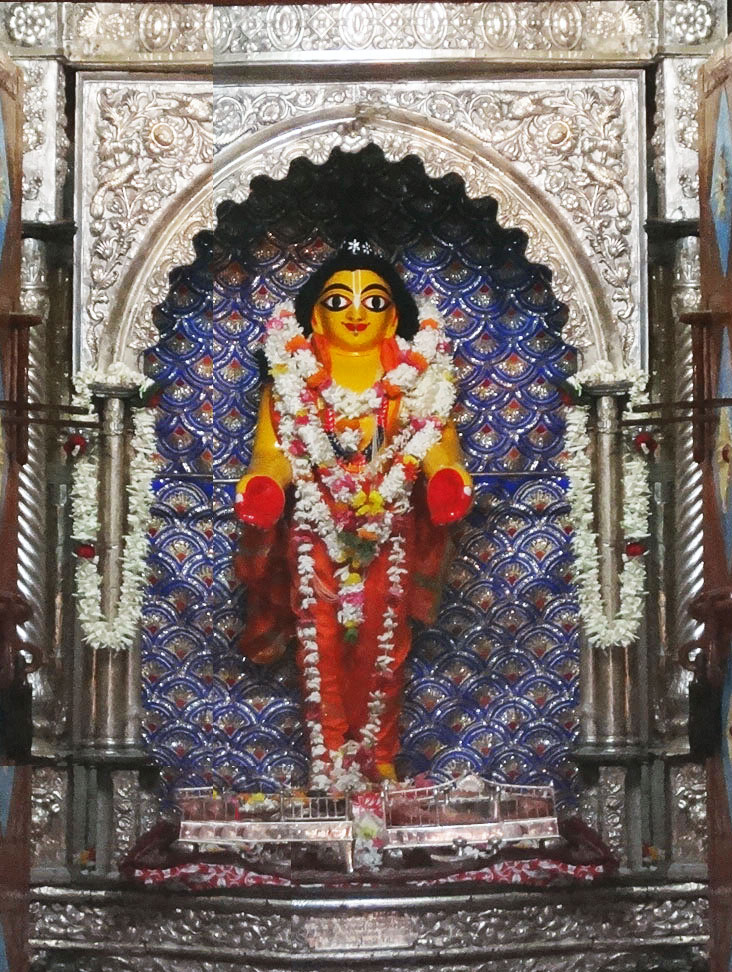
(The holy Deity of Sriman Mahaprabhu served by Sri Vishnupriya Devi.)
Coming here, we have an opportunity to have the darshan of Dhamesvar Mahaprabhu’s Deity that was served by Sri Vishnupriya Devi. We must always remember the sacrifice Sri Vishnupriya Devi made in her life. This life is not for enjoyment. The purpose of this life is to sacrifice. We must learn from Sri Vishnupriya Devi. She was only a fourteen-year-old girl, but she gave up everything in her life: she even gave up the Supreme Lord and the dearmost master of her very life. But we cannot give up even some small trifle things (we cannot even give up drinking tea!). We must throw our own happiness away. Devotees never think about themselves – they always only serve the Lord and always think about the Lord’s happiness. Devotees always think, ‘How can I please my Lord, my guru?’ Vraja gopis also say, ‘Even if we go to hell, we do not mind it – the Lord’s happiness is all that matters. Whatever makes Him happy is the source of our true happiness.’
We have also heard one very esoteric discourse from the holy lotus mouth of our Sri Gurupadpadma. There is a verse mentioned in Sri Chaitanya-charitamrita (2.13.145) that came out of Sri Radharani’s mouth:
na gani apana-duhkha, dekhi’ vrajesvari-mukha,
vraja-janera hrdaya vidare
kiba mara’ vraja-basi, kiba jiyao vraje asi’,
kena jiyao duhkha sahaibare?
‘I do not care for My personal unhappiness, but when I see the morose face of Mother Yasoda and the hearts of all the inhabitants of Vrindavan breaking because of You, I wonder whether You want to kill them all or whether You want to enliven them by coming there? Why are You simply keeping them alive in this state of suffering?’
She said, ‘We are not considering our heart pain, but when we see Mother Yasoda’s face, and Mother Yasoda’s situation without Your presence, our heart is breaking after breaking after breaking… This is happening, and we cannot tolerate this pain. We can tolerate our own pain, but we cannot tolerate to see Mother Yasoda’s pain.’
We can see a similar situation in the pastimes of Mahaprabhu. When Mahaprabhu decided to take sannyas, He told about it to five people, one of whom was Sri Sachi Mata. She fainted to hear it, but Mahaprabhu showed His divine form to Sachi Mata and said, ‘Who are you and who am I? You know everything.’ Nimai comforted and gave nourishment to Sachi Mata, but it helped only for a short time. When Mahaprabhu finally left, Sachi Mata immediately went into a coma-like state: she sat outside the house, and Mahaprabhu touched her lotus feet and went away to Kesav Bharati’s ashram… Sachi Mata made no expression at that time: she only remained sitting there like a stone statue.
We always remember the pain of Radharani and Her associates, the Vraja gopis, but we forget how much pain, how much suffering Nanda Maharaj, Yasomati Mayi and Sachi Mata got. ‘I do not care for My personal unhappiness, but when I see the morose face of mother Yasoda and the hearts of all the inhabitants of Vrindavan breaking because of You, I wonder whether You want to kill them all or whether You want to enliven them by coming there? Why are You simply keeping them alive in this state of suffering?’ – Srimati Radharani asked Krishna this question. In reply, Krishna said, ‘I come to Vraja Dham every day. You think it is all illusion or a dream, but it is not so – I come personally.’ Radharani believed Him. Describing the agony of separation that devotees experience, Srila Krishna Das Kaviraj Goswami wrote (2.2.29–35):
vamsi-ganamrta-dhama, lavanyamrta-janma-sthana,
ye na dekhe se chanda vadana
se nayane kiba kaja, paduka tara munde baja,
se nayana rahe ki karana
‘Of what use are the eyes of those who do not see the face of Krishna, which resembles the moon and is the birthplace of all beauty and the reservoir of the nectarean songs of His flute? Oh, let a thunderbolt strike their heads! Why do they keep such eyes?’
sakhi he, suna, mora hata vidhi-bala
mora vapu-chitta-mana, sakala indriya-gana,
krsna bina sakala viphala
‘My dear friends, please hear Me. I have lost all providential strength. Without Krishna, My body, consciousness, mind as well as all My senses are useless.’
krsnera madhura vani, amrtera tarangini,
tara pravesa nahi ye sravane
kanakadi-chhidra sama, janiha se sravana,
tara janma haila akarane
‘Talks about Krishna are like waves of nectar. If such nectar does not enter one’s ear, this ear is no better than the hole of a damaged conchshell. Such an ear is created for no purpose.’
krsnera adharamrta, krsna-guna-charita,
sudha-sara-svadu-vinindana
tara svada ye na jane, janmiya na maila kene,
se rasana bheka-jihva sama
‘The nectar from the lips of Lord Krishna and His transcendental qualities and characteristics surpass the taste of the essence of all nectar, and there is no fault in tasting such nectar. Those who do not taste it should die immediately after birth, and their tongues are to be considered no better than the tongue of a frog.’
mrga-mada nilotpala, milane ye parimala,
yei hare tara garba-mana
hena krsna-anga-gandha, yara nahi se sambandha,
sei nasa bhastrara samana
‘One’s nostrils are no better than the bellows of a blacksmith if one has not smelled the fragrance of Krishna’s body, which is like the aroma of musk combined with that of the bluish lotus flower. Indeed, such combinations are actually defeated by the aroma of Krishna’s body.’
krsna-kara-pada-tala, koti-chandra-susitala,
tara sparsa yena sparsa-mani
tara sparsa nahi yara, se yaike chharakhara,
sei vapu lauha-sama jani
‘The palms of Krishna’s hands and the soles of His feet are so cool and pleasant that they can be compared only to the light of millions of moons. One who has touched such hands and feet has indeed tasted the effects of a touchstone. If one has not touched them, their life is spoilt and their body is like iron.’
kari’ eta vilapana, prabhu sachi-nandana,
ughadiya hrdayera soka
‘Lamenting in this way, Sri Sachinandan Gaura-hari exposed the grief He kept within His heart.’
Therefore, coming to this abode of separation, we are remembering the pastimes of devotees’ divine separation and continuing our parikrama. We do not know in which birth we will be able to understand this or in which birth we will be able to develop the service mood to enter this highest domain of devotion, but it is our greatest fortune that we, albeit so lowly and vile, have still got a chance to join the current of this Sri Rupanuga line in this life.
To conclude, we would like to present here a jewel of an article about Sri Vishnupriya Devi and her divine nature that we find published previously in our Sri Gaudiya Darshan magazine.
Appearance day of Sri Sri Vishnupriya
(Reprinted from the weekly Gaudiya)
Sri Vishnupriya Devi is the embodiment of transcendental pure loving devotion (prema-bhakti). It is impossible to attain pure loving devotion without her mercy. In the pastimes of Sri Gaura-Narayan, she is the embodiment of Gaura-Narayan’s bhu-sakti. The perception of Gaura-Narayan is based on morality, and it is the mood of servitude (transcendental devotion of the lawful wife) that predominates there. There is no place whatsoever for the common material relationship between the wife and the husband there. She is the housewife at Sri Gaura’s household. If one establishes themselves in strict devotional adherence to her, then material existence, where the mundane conceptions of the enjoyer and the enjoyable predominate, being born from the base discrimination between male and female, will be removed, and the jiva soul will attain the right to enter the house of Sri Gaura, with the aspiration awakening within them to gain the qualification to serve there the holy marketplace of the Holy Name as some cleaning utensil.
It is mentioned in some places that Sri Vishnupriya Devi is Sri Satyabhama, the vamya-svabhav (leftist and feisty) lawful spouse of Dvarakes Sri Krishna, who had a loving relationship with many ladies, but the peculiarity there is such that Sri Krishna begot children from the actual union with the Queens Sri Rukmini-Satyabhama, but no such pastime is manifest in relation to Sri Vishnupriya Devi: she is always considered an embodiment of Laksmi Devi in the pastimes of Sri Gaura-Narayan, following the line of exclusive morality. Unlike the pastimes of Krishna, the pastimes of Sri Gaura-Narayan show no pastimes of engaging in loving relationship with multiple ladies.
In the pastimes of Sri Gaura Visvambhar, Sri Vishnupriya is an embodiment of loving devotion, a worshippable Deity-like plenary incarnation of Srimati Vrisabhanu-nandini; being ardently devoted to Sri Varsabhanavi (Sri Radhika), she nourishes the pastimes of divine separation from Vrajendra-nandan, being absorbed into Sri Radha’s divine mood. In her trying to prevent the pastime of Sriman Mahaprabhu’s sannyas, there is no trace of any conception of enjoyment or physical union. If someone tries to show much devotion to Sri Vishnupriya Devi and gets busy trying to bring her to the Gambhira room at the house of Kasi Misra in Nilachal to get her to unite with Sri Gaurasundar, such people are great offenders to the holy lotus feet of both Sri Gaurasundar and Sri Vishnupriya – they are antagonists of the conception of pure devotion, wickedly guilty of rasabhas (offensive mixing of devotional moods) and extremely offensive prakrita-sahajiyas (gross imitators). Although Sri Gaura-Narayan and Sri Gaura-Visvambhar are actually non-different from each other (situated beyond duality), there are characteristic peculiarities of Their manifest pastimes as well as distinct compartmentalisation of Their pastimes, and the immature folly and vision of those who try to meddle with these distinct peculiarities of Their pastimes are absolutely contemptible.
Sri Vishnupriya Devi, Sri Nityananda, Sri Advaita, Sri Gadadhar, Srivas, et al. are all our spiritual teachers (acharyas) – they are worshippable Deities, non-different from Sri Gaurasundar; they are Sri Gaurasundar Himself. However, there is some distinction: although Sri Gaurasundar is an acharya, He is also the Lord of all acharyas. Although Sri Nityananda, Sri Advaita and others are masters, they predominantly perform the role of servants.
Sri Vishnupriya is the embodiment of transcendental loving devotion to Sri Sri Gaura-Visvambhar, and by getting even a slightest trace of her mercy, jiva souls become blessed – it increases their firmness in practising chanting the Holy Name in strict devotional adherence to Sri Guru and Vaishnavs. Sri Vishnupriya Devi teaches and embodies a perfect example of worshipping the Lord in the pastime of separation from Sri Gaurasundar through her chanting of His Holy Names. When, right after Mahaprabhu’s disappearance pastime, Srila Srinivas Acharya Thakur met with Sri Gadadhar Pandit in Nilachal and on his order travelled to Sri Dham Mayapur, he got the darshan of Sri Vishnupriya Devi and the old Vaishnav Sri Isan Prabhu in Sri Dham Mayapur-Yogapith. These events are described in detail in the holy books of Bhakti-ratnakar (4th Taranga) and Prema-vilasa. Sri Vishnupriya chanted the Holy Name counting grains of rice (she would chant sixteen Holy Names of thirty-two syllables and then keep aside a grain of rice; she kept two new clay pots, one empty and the other filled with rice). Then, she would cook whatever rice she managed to keep aside in this way, offered it to Mahaprabhu and then took only a part of that as prasad. Even when she was taking prasad, she would chant the Holy Name in separation. In this way, her days and nights passed in worship and in chanting the Holy Name.
It is mentioned in Bhakti-ratnakar (10th and 12th Taranga), Prema-vilas (19th Vilas) and Sri Narottama-vilas (6th Vilas) that Srila Narottam Thakur Mahasaya established together with ‘Priya’ six Deities in Kheturi on Phalguni Purnima: Gauranga, Vallabi-kanta, Sri Krishna, Vraja-Mohan, Radhakanta and Radha-Raman. It is also heard that with the permission of Sri Narahari Sarkar Thakur, the son of Sri Raghunandan (Srila Thakur Kanai) manifested in Srikhanda the service to the Deities of Sri Gauranga with Sri Vishnupriya Devi on His left. Srila Bhaktivinod Thakur also manifested the service to the Deities of Sri Gauranga accompanied by Sri Vishnupriya Devi on the Phalguni Purnima, Wednesday, 9 Chaitra 1300 (21 March 1894).
The authors of Sri Chaitanya-bhagavata (1.10.48) and Sri Gaura-ganoddesa-dipika describe Sri Vallabhacharya as simultaneously Janaka and Bhisma, and his daughter Laksmipriya Devi as Laksmi, embodying both Janaki and Rukmini at the same time. Additionally, Sri Chaitanya-bhagavata (1.15.59) describes Sri Vishnupriya Devi as being also an embodiment of Rukmini:
“yena krsna rukminite anyo’nya uchita
sei-mata Vishnupriya nimai pandita”
‘Vishnupriya and Nimai were as good a match as Krishna and Rukmini.’
In Sri Gaura-ganoddesa, Sri Sanatana Misra is described as King Satrajit in Krishna-lila; and Sri Vishnupriya Devi, as the daughter of this Satrajit, princess Satyabhama, the mother of the world and the embodiment of the Lord’s bhu-sakti. As Satyabhama and Rukmini are incarnations of Sri Vrisabhanu-nandini, Sri Vishnupriya Devi can also be called an incarnation of Sri Vrisabhanu-nandini.
If, saying that Sri Vishnupriya Devi is Radha (the source of all expansions), someone tries to say that Sri Gaura and Sri Vishnupriya are Sri Radha-Krishna, such people are the most terrible offenders to both because they seek to destroy the distinctive peculiarities of Their pastimes.
There is never any wanton pastimes of Gaurasundar, an embodiment of Sri Radha’s heart and halo.
“ataeva yata mahamahima sakale
gauranga-nagara,—hena stava nahi bale”
‘Great personalities never glorify Gauranga as a womaniser.’
(From the lotus mouth of Srila Vrindavan Das Thakur)
Remembering the astakaliya pastimes of Sri Gauranga (the pastimes during the eight divisions of the day), Srila Visvanath Chakravarti Thakur is said to have described various interactions between Gaura and Vishnupriya, but there is no question of transgressing the distinctive quality of the pastimes of Sri Laksmi and Gaura-Narayan there.
Because Sri Vakresvar Pandit called Sri Vishnupriya ‘Sri Radha’, there is a certain opinion common among the members of the gaura-nagari sampradaya (imitators that imagine Gauranga Mahaprabhu to be enjoying with many ladies). Followers of the pure Gaudiya line know that even when Sri Vishnupriya Devi is called Sri Radha, there can never be any transgression of the distinctive quality of Sriman Mahaprabhu’s householder pastimes and the pastimes of His renounced life. Sri Radha, the source of all expansions, manifests Her expansion as Vishnupriya – in this sense, who else can Vishnupriya be beyond being Sri Radha? However, there are transcendental peculiar characteristics and distinctions between the pastimes of Sri Radha-Govinda and the separation pastimes of Krishnachandra couched into Sri Radha’s heart and halo as well as the pastimes of Sri Gaura-Narayan and Sri Laksmi-Vishnupriya; these differences exist eternally.
In the past, Srila Prabhupad wrote to one devotee the letter presented below, dated 11 Ashadh 1336 (22 June 1930), regarding the appropriateness of having Vishnupriya Palli in Sri Dham Mayapur:
Dear Affection Incarnate,
It is necessary to have Sri Vishnupriya Palli in Sri Dham Mayapur, but those who reject strict adherence to Sri Vishnupriya and embrace independence should have no place in Sri Mayapur. * * has had Vishnupriya Palli arranged for seven days already, assuming the role of a father or a son of female devotees, and there has been no trouble in the course of this time.
* * * Female devotees must serve Sri Mahaprabhu following Vishnupriya with exclusive devotion. They must not act independently. * * *
Being situated within the religion of householders, Srila Bhaktivinod Thakur and Prabhupad did not become residents at their cherished Vishnupriya Palli. When one receives even the slightest trace of Vishnupriya Devi’s mercy, one becomes free from the religion of householders. There is eternal difference between the followers of pure Gaudiya line and the grhi-baul sampradaya that compare the family life of the Supreme Lord Sri Gaurasundar and His associates with the family life of conditioned souls that revolves around sense gratification.
Srila Bhaktivinod Thakur sang:
sarasvati krsnapriya, krsna-bhakti tan’ra hiya,
vinodera sei se vaibhav
‘The devotion to Lord Krishna that is found within the hearts of Saraswati and Krishnapriya is Vinod’s wealth and opulence.’
Sri Vishnupriya is Suddha Saraswati (Pure Saraswati);
she is the presiding Deity of transcendental knowledge; she is Saraswati Devi residing happily on the tongue of Sri Gaura-Nrisimha. She bestows eternal spiritual benefit on all jiva souls by personifying pure speech or the practice of chanting the transcendental sound vibration of the Holy Name. Unfortunate jiva souls are deprived of her mercy – they worship material knowledge that embodies obstruction to spiritual life in service to Lord Krishna, and being seized by the cravings for enjoyment and salvation, they do not have the guts to kick this knowledge that creates obstacles to devotion in the head, singing the words of great souls, ‘Mastakete padaghata kara akaitava. I will with all sincerity kick it in the head.’
Even if you give hundreds of lectures on the difference between material knowledge and transcendental knowledge, people with limited intelligence will still remain deprived, being unable to sing the victorious hymn of Krishna-sankirtan, embarking on a new life in transcendental knowledge (para-vidya-vadhu-jivanam).
In Sri Chaitanya-chandrodaya Nataka, Sri Vishnupriya Devi is called a personification of Devotion (Bhakti Devi herself).
Srila Bhaktivinod Thakur wrote about the nature of Sri Gaura-Vishnupriya in his Jaiva-dharma (chapter 14) as follows:
Question: In which way does Sri Gauranga’s yugala aspect manifest?
Answer: Gauranga’s yugala aspect is of two kinds, depending on the approach (the path of Deity worship or the path of devotional service). According to the path of Deity worship, Sri Gauranga is worshipped as Sri Gaura-Vishnupriya, and according to the path of devotional service, He is worshipped as Sri Gaura-Gadadhar.
Question: Which energy of Sri Gauranga is Sri Vishnupriya?
Answer: Generally, devotees call her His bhu-sakti. In fact, she is the samvit-sakti, the personified essence of hladini, which means that she is a personification of Devotion: she came to assist Sri Gaura’s avatar in preaching about the Holy Name of the Lord. Just as Sri Nabadwip Dham embodies the nine kinds of devotion on its nine islands, Srimati Vishnupriya Devi is similarly a personification of the nine kinds of devotion.
Question: But is Sri Vishnupriya svarupa-sakti of the Lord?
Answer: What doubt can there be? Is the samvit-sakti and the personified essence of hladini of the Lord’s svarupa-sakti not svarupa-sakti?
Sri Srila Prabhupad spoke about Sri Gaura-Vishnupriya in the following way:
‘When Sri Gaurasundar manifested His pastimes prior to His arrival in Gaya, these pastimes were manifest as the opulent pastimes of Lord Narayan. In His householder pastimes, Sriman Mahaprabhu revealed His Narayan form. The householder pastimes of Laksmipriya and Gaura must be known as the pastimes of Laksmi-Narayan in Vaikuntha. In Gaura-ganoddesa (43), Kavi Karnapur said that he who was known as Janaka, the king of Mithila, is Vallabhacharya in the incarnation of Gaura, and this Vallabhacharya had a daughter, Laksmipriya. Both Janaki and Rukmini combined into one and became his one daughter called Laksmi. Just before Sri Gaurasundar manifested His internal nature filled with transcendental loving devotion, Sri Laksmi disappeared, which means when the personification of transcendental loving devotion, Sri Vishnupriya, was coming into prominence, Laksmipriya existed beautifully as a servant of Gaura-Narayan. Eventually, when transcendental loving devotion came into prominence and became fit to serve Sri Gaurasundar, Laksmi Devi disappeared. If we consider her spiritual position, Sri Vishnupriya Devi is an embodiment of bhu-sakti. In Gaura-ganoddesa, Sri Kavi Karnapur wrote that he who was King Satrajit is referred to as Raja Pandit Sanatan in the incarnation of Gaura. The personification of ‘bhu’ (the mother of the world), Sri Vishnupriya, is his daughter. In Sri Chaitanya-chandrodaya Nataka, Kavi Karnapur called Sri Vishnupriya Devi a plenary expansion of Earth. Vishnupriya Devi assists Sri Gaurasundar’s transcendental loving devotion. Sri Gaurasundar is the combined form of Sri Radha-Krishna; therefore, it can be said that the mother of the world, the loving motherly guardian of all devotees, Vishnupriya, is a maidservant of Radha-Krishna. She can be referred to as Paramesvari, a devotee and an assistant of Sri Vrisabhanu-nandini. The character Sri Gaurasundar showed in His early pastimes (before His journey to Gaya) was the character of Lord Narayan. He accepted Sri Laksmipriya and Sri Vishnupriya as His lawful spouses. After He returned from Gaya, He also showed the pastimes that involved mixed devotional mood: His opulence was still visible. For example, He showed His four-armed form of Nrisimha at the house of Srivas Pandit, He showed His form of Varahadev at the house of Murari Gupta, etc. Sometimes, He also lay on the cot prepared as the throne for worshipping Lord Vishnu.
‘In the final pastimes of His stay at home, He was overwhelmed with the mood of Radha and spoke about the conjugal pastimes of Krishna, revealing them to this world. At the same time, it is not true that He did not speak about the pastimes of Krishna during the middle period of His pastimes, when He was a householder. After returning from Gaya, His showed His own form, overwhelmed with the mood of a shelter-giver, and cried, repeating, “Gopi”, “Gopi”. He ordered Thakur Haridas and Sri Nityananda to chant and speak about the glories of Krishna, going door to door in this world.’
(From Sri Saraswati Samlap, 23)
Before manifesting the pastime of accepting sannyas, Sri Gaurasundar gave Sri Vishnupriya advice that is recorded in the Madhya-khanda of Sri Chaitanya-mangala:
tora nama visnupriya, sarthaka karaha iha,
michha soka na karaha chite
e tore kahilun katha, dura kara ana chinta
mana deha krsnera charite
‘“Your name is Vishnupriya [who is dear to Lord Vishnu], so fulfil its meaning. There is no need for all this false grief in your heart. I have told you everything, so do away with all your worries and dedicate your mind and body to Krishna consciousness.’”
We see how Vishnupriya Devi, the mother of the world, placed this advice on her head and followed the practice Sri Gaurasundar, the embodiment of divine separation, adopted in His search for Sri Krishna, which is described in Sri Bhakti-ratnakar (4th Taranga) as follows:
“prabhura vichchhede nidra tejila netrete
kadachit nidra haile sayana bhumite”
‘Feeling separation from the Lord, she cried so much that she stopped sleeping, and sometimes when she did fall asleep, she slept right on the ground.’
“kanaka jiniya anga se ati malina
krsna-chaturddasira sarira praya ksina”
‘Her limbs that used to be adorned with gold are now soiled, and her fourteen-year-old body became virtually emaciated.’
“harinama samkhya purna tandule karaya
se tandula paka kari’ prabhure arpaya”
‘She chanted the Holy Name and counted it with grains of rice – when she completed chanting a certain number of times, she cooked that rice and offered it to the Lord.’
“tararai kinchin-matra karena bhajana
keha na janaye kene rakhaye jivana”
‘From that, she ate only a little. Nobody knows how she kept her body and soul together.’
If we are to become sincerely (without any sinful purposes) firm in following the example of spiritual life that was shown by Sri Vishnupriya Devi, we will embrace the great fortune of being able to join the grand festival of remembering Sri Gaura in the holy abode of Sri Gaura in the association of Sri Gaura’s associates – throwing ourselves into the great sacrificial fire of sankirtan at the sankirtan-rasa-sthali revealed by Sri Gaurasundar, we will attain the highest auspicious opportunity to become servants of the servants at a dwelling established by Sri Chaitanya Saraswati next to this sankirtan-rasa-sthali, the place where everything favourable to Krishna consciousness is practised.
Jay Sri Vishnupriya Devi ki jay.
Srila Guru Maharaj ki jay.
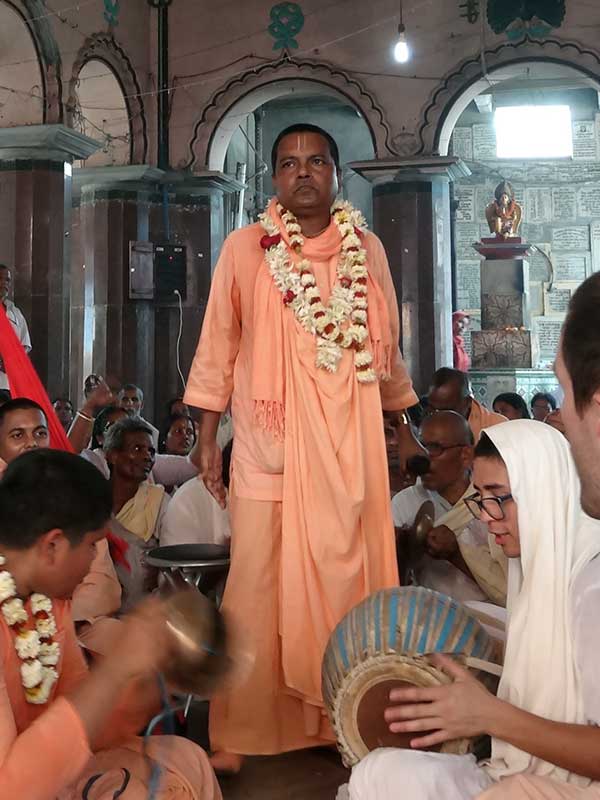
(His Divine Grace Srila B.N. Acharya Maharaj chanting at the
nat-mandir of Sri Vishnupriya Devi's house.)
— • • • —
|
|
Sitemap | Contact us | About us