
Our Disciplic Succession:


|
"The Sun Never Sets on Sri Chaitanya Saraswat Math":
|
| ABOUT US | GUIDANCE | LIBRARY | DAILY PRACTICE | PHOTO | CALENDAR | CONTACT | বাংলা |
SRI NABADWIP DHAM MAHATMYA-MUKTA-MALA
Modadrumdwip (dasyam: servitude)
Land of Childhood Pastimes of Srila Vrindavan Das Thakur
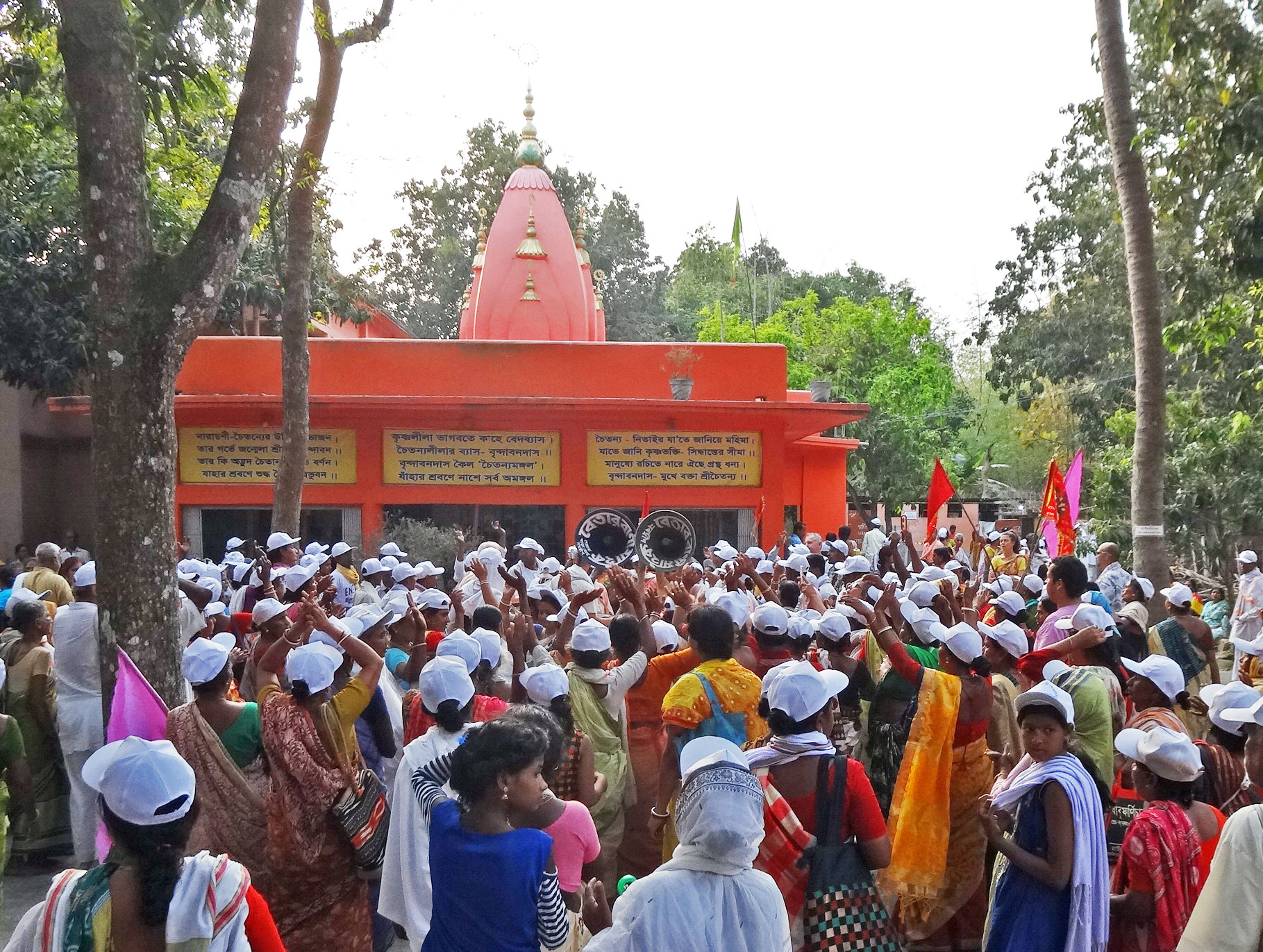
As we proceed with the parikrama of Sri Nabadwip Dham, we have reached our last stop – this beautiful temple situated in the village of Mamgachi within Sri Modadrumdwip. This is the place where the supremely worshippable ‘Vyasa of Sri Chaitanya-lila’ – Srila Vrindavan Das Thakur – was born. This is his birthplace. Our Srila Guru Maharaj, Om Vishnupad Srila Bhakti Sundar Govinda Dev-Goswami Maharaj, wrote the pranam-mantra of Srila Vrindavan Das Thakur and Srila Krishna Das Kaviraj Goswami Prabhu:
dasa-vrndavanam vande krsna-dasa-prabhum tatha
chhannavatara-chaitanya-lila-vistara-karinau
dvau nityananda padabja-karuna-renu-bhusitau
vyakta-chchhannau budhachintyau vavande vyasa-rupinau
sri-guru-gaura-gandharva-govindas cha ganaih saha
jayanti pathakas chatra sarvesam karunarthinah
‘I offer my obeisance to Srila Vrindavan Das Thakur and Srila Krishna Das Kaviraj Goswami, who made public the pastimes of the hidden avatar, Sri Chaitanya. They were both adorned with the mercy-dust of the lotus feet of Nityananda. I offer my obeisance to these two inconceivable sages who assumed the form of Vyasadev, one explicitly (Vrindavan Das Thakur) and the other one secretly (Krishna Das Kaviraj Goswami). Glory to Sri Sri Guru Gauranga Gandharva Govinda and Their associates! We, students, pray for Their mercy.’
When we went to the house of Srivas Pandit, we spoke about Sri Narayani Devi:
One day, Mahaprabhu was taking prasadam at the house of Srivas Pandit when Narayani suddenly came in front of Mahaprabhu with an outstretched hand. She was about three or four years old at that time. Mahaprabhu gave her some prasad and said, ‘Now cry and chant “Krishna”!‘ Affected by the order of Mahaprabhu, Narayani started to cry and chant, ‘Krishna! Krishna!’
Another time, some neighbours heard Srivas Pandit chant kirtan with devotees late at night. Becoming jealous and annoyed, they started complaining, ‘It is so late, we cannot sleep! All day and night they do their kirtan! They must stop it; otherwise, we will have to beat Nimai and we will break Srivas’s house and throw it into the Ganges!’
Hearing their angry words, Srivas Pandit stopped kirtan from the next day, but that day Sriman Mahaprabhu came to his house and asked, ‘Srivas, what has happened? Why did you stop kirtan?’
Srivas Pandit replied, ‘First come in, do not worry about it. Take a seat.’
‘Why must I sit? Why has the kirtan stopped? Speak up.’
‘Do not get excited, sit. Neighbours are saying that they will break the house and throw it into the Ganges. I do not care about it, but they also say that they will raise their hands on You. How can I let anyone touch You?’
Mahaprabhu replied, ‘Oh, is that so?’ Then, He showed His transcendental power: He put His hand on Narayani’s head and blessed her, ‘May you get devotion to Lord Sri Krishna!’ Narayani at once cried, ‘O Krishna! O Gaura!’ and started rolling on the ground. After that, Mahaprabhu said to the devotees, ‘So, do you believe it now, or do you still think that anyone can break your house?’ Everyone then believed Mahaprabhu and never stopped kirtan again.
On account of all this, Narayani became renowned as ‘Narayani, the Recipient of Gauranga’s Remnants.’ A few years later, they arranged her marriage into the paternal house of Malini Devi in Mamgachi. The name of her husband is not mentioned anywhere in the scriptures; however, soon after her marriage she begot a son, an exalted Vaishnav called Srila Vrindavan Das Thakur. Such was her fortune.
When Srila Vrindavan Das Thakur grew up, he always served Sri Nityananda Prabhu and preached together with Him. After Mahaprabhu took sannyas, He told Sriman Nityananda Prabhu, ‘Go and preach in Rarhdes!’ Following this order, Sriman Nityananda Prabhu returned to Rarhdes [the Bengal area to the west of the Ganges] and started preaching there in various ways. Apart from that, once every year, He would take all the devotees from Nabadwip to Sri Puri Dham.
One day, Sriman Nityananda Prabhu, together with devotees, started the journey from Nabadwip. On their way, they were passing a village called Denur, so they decided to stop in a mango grove there to take some rest.
Ramahari Chakravarti, the landowner of Denur, was a brahman and a big devotee of Nityananda Prabhu. He always thought, ‘When will I be able to see Nityananda Prabhu? When will Nityananda Prabhu come?’ So, when that day Ramahari Chakravarti suddenly saw a big colourful crowd from a distance – some wore yellow clothes; some, blue; some, red; some, white, etc. – he was surprised, ‘What is this? Let me go and see what is going on!’
He came to the mango grove and saw that Sriman Nityananda Prabhu Himself was standing there! Seeing his gurudev, Ramahari Chakravarti immediately fell on the ground, offering his prostrate obeisance to Nityananda Prabhu. When he got up, he said, ‘Prabhu, I am always thinking about You. Please come to my house! I will give everyone prasad!’
‘How?’ Nityananda Prabhu replied. ‘There are so many of us here. How are we all going to fit in your house? You know, better bring whatever rice, dal, etc. you have, and we can make a picnic here.’
Excited, Ramahari Chakravarti made all arrangements and distributed prasadam to everyone very nicely.
After taking prasad, Sriman Nityananda Prabhu said to His servant, Srila Vrindavan Das Thakur, ‘Where is My thing?’ Vrindavan Das Thakur immediately understood what Nityananda Prabhu wanted, it was not necessary to say what thing it was. Vrindavan Das Thakur gave Nityananda Prabhu a haritaki fruit (used as a mouth freshener). Seeing that haritaki, akrodha-paramananda (always-joyful-and-never-angry) Nityananda Ray flared up. He asked Vrindavan Das Thakur, ‘Where did you get it from so quickly??’ Vrindavan Das Thakur explained, ‘Prabhu, when You were taking prasad in the morning, a devotee gave me a few haritaki fruits knowing that You take it every day. I gave You some in the morning, and I have kept some away to give You later during the day.’
He told the truth, but Nityananda Prabhu became angry when He heard it, ‘With your hoarding mood, you are just like a householder! You are keeping and hoarding things for tomorrow!’ (Householders keep things for the next day, worrying, ‘What will I eat tomorrow? What will I wear tomorrow?’ They always think, ‘When I grow old, who will take care of me?’) So, finally, Nityananda Prabhu said, ‘If your mood is like this, then you must not come with Me! Stay at the house of Ramahari and preach here.’
It was a very simple matter, but why did Nityananda Prabhu become angry? Vrindavan Das Thakur did not do anything wrong: he kept some fruit for his guru, what fault is there in doing it? However, the main point here is that Nityananda Prabhu cannot preach everywhere alone, so He used that situation as a pretext to keep Srila Vrindavan Das Thakur in Denur.
Vrindavan Das Thakur placed the order of Nityananda Prabhu on his head and followed it: throwing away his own happiness and unhappiness, he settled in Denur. This is where he wrote his famous scripture Sri Chaitanya-bhagavata; this is where his Deities of Nityananda Prabhu and Mahaprabhu are; and this is where his holy samadhi-mandir is. This is a brief account of how his life went.
Srila Vrindavan Das Thakur composed Sri Chaitanya-bhagavata, and when everybody read it, they thought the title appeared to be wrong – this scripture should have been called Sri Nityananda-bhagavata because he actually wrote more about Nityananda Prabhu than Mahaprabhu. Such was his deep attachment to the holy lotus feet of Sri Nityananda Prabhu.
Just a hundred years ago, this holy place was completely neglected. When Bhagavan Srila Bhaktisiddhanta Saraswati Thakur Prabhupad first inaugurated Sri Nabadwip Dham parikrama, he re-discovered, one by one, virtually all places. In 1921, he acquired this land in the birthplace of Srila Vrindavan Das Thakur and first built here a shelter; a few years later, in 1938, he made this beautiful temple and established the Deities here. By the mercy of his holy lotus feet, we are able to come here today and get an opportunity to remember the pastimes and glory of Srila Vrindavan Das Thakur.
* * * * * * * * *
In 1967, our Param Guru Maharaj, Srila Bhakti Raksak Sridhar Dev-Goswami Maharaj, wrote a short article about Srila Vrindavan Das Thakur. We are presenting this article below for the eternal benefit of the readers.
Srila Vrindavan Das Thakur
Sri Gaurangasundar, the Lord of my Lord (‘amara Prabhura Prabhu Gauranga-sundar’), advised, ‘Those who are humbler than a blade of grass, more tolerant than a tree, who do not desire any honour and can give honour to others are qualified to always chant the Holy Name’ (‘trnad api sunichena…’); but Vrindavan Das Mahasaya, the ‘Vyasa of Sri Chaitanya-lila’, said, ‘If any sinner disregards this and makes any offence, I will kick this sinner on the head!’ How can this be harmonised? I thought that a devotee would rather show intense, heart-felt sadness – there is no such consideration here. But what is this? Vaishnav Acharya said: by doing so, Thakur has shown extreme mercy to jiva souls. How is it so? Taken aback and amazed, I became quite intrigued to understand this. Acharya continued: in the cases when the Supreme Lord, or even many spiritual teachers, ignore great offenders, Thakur Vrindavan does not ignore such sinners – personally taking responsibility for them, he bestows punishment on them. Here, establishing a good or a bad relationship with the clan of such ‘candidates for Lord Yama’s punishment, who are not worth being looked at or touched’ (‘asprsya adrsya sei haya yama-dandya’), he pulls them into the court of the Supreme Lord. When it comes to fighting for the dignity of His devotees, the Lord has given some sugar-coated concession to the protesting party; moreover, He explained that, first, unknown to them, they are given a grant to ensure termination of their eternal poverty: ‘Bhakta-pada dhuli ara bhakta-pada-jala bhakta bhukta sesa ei tina sadhanera bala. The dust of devotees’ feet, the water that has washed devotees’ feet and devotees’ food remnants – honouring these three gives one strength to practise Krishna consciousness’ – if they can meditate on this formula, they can fulfil their goal. When you are charged with a stick or kicked, where else will you go to if not to the authority? ‘No war, no booty’: if you file with the authorities a complaint against the police (according to the logic, ‘it takes some effort to produce powder’), then it is possible to gain something – must this be taught again in this present day and age? Therefore, think hard and try to understand how indebted you all are to Sri Vrindavan Thakur for settling your disputes! Our Master says so, so it must be true. Coming to loot Sri Vrindavan’s wealth, we will create even more unrest. However, Acharya said: when they came to loot, they got such greatly valuable treasure that they forgot all about informing the authorities and stealthy started a great festival of chanting and dancing within their overflowing hearts. The motto here was, ‘The worship of My devotees is higher than My worship.’ The dust of devotees’ feet, the water that has washed devotees’ feet and devotees’ food remnants – honouring these three gives one strength to practise Krishna consciousness.
* * * * * * * * *
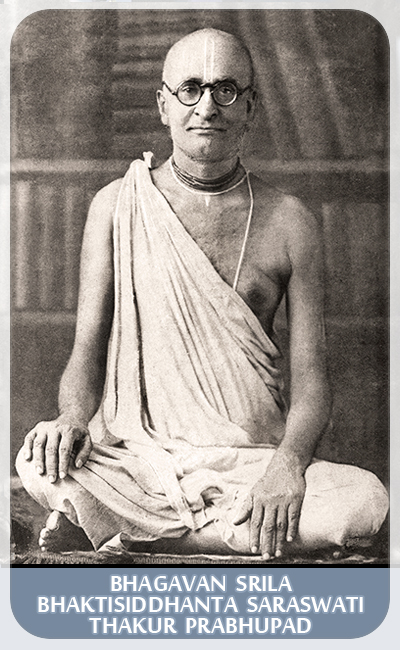
Additionally, we find one more invaluable article coming from the pen of Bhagavan Srila Bhaktisiddhanta Saraswati Thakur Prabhupad:
— Life of Srila Vrindavan Das Thakur —
(By Prabhupad Srimad Bhaktisiddhanta Saraswati Thakur)
Within the Purbasthali Police Station in Bardhaman District, there is an ancient village called Mamgachi that exists to this day. The elders and the author of Bhakti-ratnakar instruct that this Mamgachi village is called Modadrum Island of Nabadwip. The Bhagirathi River flows on the outskirts of Mamgachi. The Deities of Sri Gaura-Nityananda, who were served by Sri Vrindavan Das, are worshipped in this village eternally. It is said that Thakur Vrindavan took birth in this village. Today, there is a place that is identified as the house of Thakur Mahasaya, where Vrindavan Das is considered to have walked and spent his childhood.
The paternal house of Srivas’s spouse, Malini Devi, was in Mamgachi. Srivas Pandit, a dear devotee of Sri Gauranga, lived in Sri Nabadwip, and his brother’s daughter, Sri Narayani Devi, got married in Mamgachi. In her final years, Malini returned to her own father’s house and lived there. Narayani was married to one of the members of Malini’s extended family, and Sri Vrindavan Das appeared from the womb of this Sri Narayani.
Thakur lost his father in his childhood: just as his venerable father became devoted to the service of Lord Sri Chaitanya-chandra, he left his body – his name is not particularly mentioned anywhere. Some say that because his father had not completely taken shelter at the holy lotus feel of the Lord, Sri Vrindavan Das Thakur’s identity is not related to the identity of his paternal family.
As of today, the holy Deities of Sri Gaura-Nityananda installed by Sri Vrindavan Das in the house of Srivas Pandit’s spouse, Malini, were moved to another place. Although They are served according to all appropriate rules and regulations, Their service does not have that same flourishing scope and effulgence now.
Sri Vrindavan Das Thakur spent much time in Denur. We do not hear anything about Sri Thakur Mahasaya accepting a family life (getting married). Among his four disciples, he bequeathed all his property in Denur to Sri Ramahari, a kayastha brahman from North Rarhdesh. To this day, this brahman’s descendants live in the house of Sri Thakur Mahasaya in Denurpat and continue the service there. Although Ramahari himself reformed and took initiation, after a few generations his descendants were eventually (under the influence of time) compelled to engage in the social customs pursuant to the smarta rules (practised rituals to obtain material gain).
We do not find much information about the identity of Srila Vrindavan Das Thakur‘s paternal family, but it is known that his father was born in a family of brahmans coming from the Rarhdesh caste. Because his maternal family were exclusively surrendered to Sri Chaitanya-chandra and were very prominent householder Vaishnavs, he is generally known by this identification in the Vaishnav world and the literary society of Gaudiya Vaishnavism.
Born from Sri Narayani, Thakur Mahasaya possessed a profound genius for devotional scriptures, and, being fixed in Vaishnav practices, tried hard, through his words, thoughts and deeds, to preach the glory of the Vaishnav guru-varga.
Because the smarta society hated Vaishnavs and were just as much overcome by hatred toward Sri Nityananda Prabhu, they always showed extreme contempt towards Sri Vrindavan Das Thakur, who was a servant of Sri Nityananda, and never gave him any elevated place at the top of their hostile-to-Vaishnavs smarta society. The deception existing at the root of this society is such that they never saw faults or even raised any question with regard to various misconceptions (inauspicious, unspiritual ideas) in the slanderous preaching, etc. practised within their families.
Shortly before Sri Gaurasundar left Nabadwip, Sri Thakur Mahasaya’s mother Narayani was only a four-year-old girl. At that time, she was a revered recipient of Sri Chaitanya-chandra’s affectionate glance. In the future, when she became a member of her husband’s household at the parental house of Sri Malini Devi, she raised and took care of her jewel of a son, Srila Vrindavan Das, until his adolescence. Falling prey to the contemporary charm of smarta brahmans, some amateur prakrita-sahajiya (gross imitationists) pseudo-Vaishnavs from Rarhdesh decided to excommunicate him from the brahman society of the time. Actually, he considered that genuine pure brahmanism rightfully took the highest position, and he never accepted subservience to the smarta society, which hated spiritual life and God. Those who studied Sri Chaitanya-bhagavata that was written by this great soul know that Thakur Mahasaya is a highest stalwart in preaching the religion of pure devotion revealed by Sri Chaitanya-chandra. At the time when Radha-raman, the son of Madhusudan (the son of Sri Advaita Prabhu’s son Balaram), lived in Shantipur and, desiring to uproot the exclusive spiritual religion preached by Sri Advaita Prabhu, became a staunch follower of the son of honourable Sri Harihara Bhattacharya; at the time when Sri Virachandra Prabhu’s three disciples, who were like sons to him, being oppressed and pushed into the frightful jaws of smarta dictates, had to place Tripura Sundari (one of the five deities worshipped by Hindus) on the same altar with the Deity of Sri Shyamasundar; when there were discussions with the Barind brahmans [brahmans coming originally from North Bengal, the area that is now mostly situated within Bangladesh] that, following the social rules and regulations of the Rarhdesh community [brahmans coming from the western bank of the Ganges] and considering the background of Ganga Thakurani, the status of the Rarhdesh community should be raised to the level of the gangopadhyaya caste [a prominent ancient Bengali brahman caste] – at this very time, the unreasonable attempts to accept, etc. such devotees as Sri Uddharan Thakur in the daiksya-savitrya caste of brahmans (initiated into the mantras and given the brahman thread) by giving them initiation were made to prevent in various ways the fame of Sri Vrindavan Das Thakur Mahasaya’s Vaishnav society from flourishing. Despite that, Thakur Mahasaya – the sun of the Gaudiya literature, Gaura’s chief devotee, whose only life and soul is Sri Nityananda – could not refrain from recording the truth in Sri Chaitanya-bhagavata. Those who study Sri Chaitanya-bhagavata very carefully cannot be swayed from the path of unalloyed truth (free from bewitching illusion) which was spoken by Sri Thakur Mahasaya.
The transcendental solutions presented by the precepts of devotion with regard to social disputes are embedded in gold letters in various places of Srila Thakur’s Sri Chaitanya-bhagavata. His service mood towards his Sri Gurudev (Nityananda) is incomparable. There are no such scholars, no contemporary society in the whole world – be it in India, Gaudadesh, Sri Nabadwip Dham or any other place – that could touch a hair on his head. In later time, in their ardent attempts to attack him, they did not hesitate to scorn his lineage or heart-felt content.
There is no scarcity of ugly-natured people willing to attack the utmost pure virtues of Sri Thakur Mahasaya. Fuelled by hatred toward Vaishnavs, some say that Sri Vrindavan Das Thakur Mahasaya and his eternal servants showed extreme callousness towards non-Vaishnavs and became incapable of attracting the love of inexperienced people with the example of the religion of tolerance and the beauty of the religion of ‘being humbler than a blade of grass’ that was preached by Sri Gaura. In reply to that, Sri Vrindavan Das’s followers said: if one wishes to criticise in this manner, then it can be said that when such ugly-natured people who oppose devotees and, couching themselves in the garb of literary lions, climb atop the holy seat of morality cheat people whilst harbouring hatred, this is indicative of their own misfortune. Because they lack spiritual merit, they have the audacity to treat the guru and Vaishnavs with such contempt. The arguments that irrational harmonisers put forward against the pure line, striving to harmonise their dry religion of strife with the all-auspicious universal religion of spiritual love, are extremely absurd and stem from envy. Sri Thakur Mahasaya is totally (with his body, mind and speech) absorbed in the service to his Guru-Nityananda; therefore, Sri Chaitanya-chandra never entrusted any powerful authors or amateur moralists to ascribe faults to Sri Thakur Mahasaya’s spiritual life. As soon as all these critics desist from their whimsical dance in the abode of six mundane enemies, they will recognise Sri Thakur Mahasaya as the only gurudev of Sri Gaudiya Vaishnavs and repent for their offences against Sri Guru.
The style in which Sri Chaitanya-bhagavata is written is very easy to understand and extremely captivating to the heart. Sri Thakur Mahasaya showed great achievement in describing Srila Haridas Thakur’s character; in describing the state of the society at the time of Sri Gaurangadev’s appearance; in establishing the literary position of the songs etc. extolling the lives of sense-enjoyers, yogis, and kings; in describing how the brahmans of those days would occasionally chant the name of Pundarikaksa (Lord Vishnu); in describing the glory, opulence, etc. of Sri Gaurasundar – seeing this great feat of his, those who can behold the beauty of the holy Gaudiya literature and who have entered the literary temple will have an opportunity to note the supra-mundane literary excellence of the residents of Gauda Mandal, who are devoid of illusory propensity for enjoyment. Gaudiya Vaishnavs are not just residents of Gaudades – with the help of the Gaudiya language (the language of Bengal), they also become adept at the language of liberated associates residing eternally in Goloka, and they can thus communicate with you speaking the theistic Gaudiya language.
I finished this lecture by reciting the words of our precursory gurudev, Srila Kaviraj Goswami, which were spoken about Sri Thakur Mahasaya:
‘ore mudha loka, suna chaitanya-mangala
chaitanya-mahima yate janibe sakala
‘O fools, hear Sri Chaitanya-mangala! If you hear it, you will understand all glories of Sri Chaitanya Mahaprabhu.
‘krsna-lila bhagavate kahe vedavyasa
chaitanya-lilara vyasa—vrndavana-dasa
‘Like Vedavyas, who told about Lord Krishna’s pastimes in Srimad Bhagavatam, Vrindavan Das is the Vyasa of Chaitanya Mahaprabhu’s pastimes.
‘vrndavana-dasa kaila chaitanya-mangala
yanhara sravane nase sarva amangala
chaitanya-nitaira ya’te janiye mahima
ya’te jani krsna-bhakti-siddhantera sima
‘Vrindavan Das composed Sri Chaitanya-mangala, by hearing which all inauspiciousness is destroyed; from this book, you can learn about all glories of Chaitanya and Nitai and understand the acme of the teachings of devotion to Lord Krishna.
‘bhagavate yata bhakti-siddhantera sara
likhiyachhena jani’ kariya uddhara
‘Srila Vrindavan Das Thakur presented the conclusion and essence of devotional service by quoting authoritative statements of Srimad Bhagavatam.
‘chaitanya-mangala sune yadi pasandi, yavana
seha maha-vaisnava haya tataksana
‘Even great atheists and low-born people can at once become great Vaisnavs by hearing Sri Chaitanya-mangala.
‘manusye rachite nare aichhe grantha dhanya
vrndavana-dasa-mukhe vakta sri-chaitanya
‘This holy book was not composed by a man – Sri Chaitanya spoke through the mouth of Vrindavan Das.
‘vrndavana-dasa-pade koti namaskara
aichhe grantha kari’ ti̐ho tarila samsara
‘I offer millions of obeisances at Vrindavan Das’s feet. By writing this holy book he delivered the whole world.
narayani—chaitanyera uchchhista-bhajana
tan’ra garbhe janmila sri-dasa vrndavana
‘Sri Vrindavan Das was born from the womb of Narayani, who received Chaitanya Mahaprabhu’s food remnants.
‘tan’ra ki adbhuta chaitanya-charita-varnana
yahara sravane suddha kaila tri-bhuvana
‘How wonderful his description of Chaitanya Mahaprabhu’s character! By hearing it, all three worlds became purified.
‘vrndavana-dasa kaila chaitanya-mangala
tahate chaitanya-lila varnila sakala
‘Vrindavan Das wrote Sri Chaitanya-mangala, describing therein all pastimes of Chaitanya Mahaprabhu.
‘sutra kari’ saba lila karila granthana
pachhe vistariya tahara kaila vivarana
‘vistara dekhiya kichhu sankocha haila mana
sutra-dhrta kona lila na kaila varnana
‘He first briefly summarised all pastimes and then described them in detail. Seeing the extensive descriptions he had written, he felt somewhat shy because he felt that some pastimes had not been captured.
‘nityananda-lila-varnane haila avesa
chaitanyera sesa lila rahila avasesa
vrndavana-dasera pada-padma kari’ dhyana
tan’ra ajna laiya likhi yahate kalyana
‘He ardently described the pastimes of Nityananda Prabhu, but the last pastimes of Chaitanya Mahaprabhu remained untold. I meditated at the holy lotus feet of Vrindavan Das and upon receiving his order, I am writing this for everyone’s benefit.
‘chaitanya-lilate vyasa—vrndavana-dasa
tan’ra krpa bina anye na haya prakasa’
‘Vrindavan Das is the Vyasa of Chaitanya Mahaprabhu’s pastimes. Without his mercy, no one can describe these pastimes.’
(Sri Chaitanya-charitamrta, Adi, ch. 8)
‘vrndavana-dasa—narayanira nandana
chaitanya-mangala yinho karila rachana
‘Vrindavan Das, the son of Narayani, composed Sri Chaitanya-mangala [Sri Chaitanya-bhagavata].
‘bhagavate krsna-lila varnila vedavyasa
chaitanya lilate vyasa—vrndavana-dasa’
‘Like Vedavyas, who described Lord Krishna’s pastimes in Srimad Bhagavatam, Vrindavan Das is the Vyasa of Chaitanya Mahaprabhu’s pastimes.’
(Sri Chaitanya-charitamrta, Adi, ch. 11)
‘chaitanya-lilara vyasa—dasa vrndavana
madhura kariya lila karila rachana’
‘Vrindavan Das is the Vyasa of Chaitanya Mahapabhu’s pastimes. His description of the Lord’s pastimes made them even sweeter.’
(Sri Chaitanya-charitamrta, Adi, ch. 13)
‘chaitanya-lilara vyasa—dasa vrndavana
tan’ra ajnaya karon tan’ra uchchhista charvana
‘Vrindavan Das is the Vyasa of Chaitanya Mahapabhu’s pastimes. Only upon his order am I trying to merely chew the food remnants he has left.
‘bhakti kari’ sire dhari’ tanhara charana
sesa-lilara sutra ebe kariye varnana’
‘Lovingly placing his holy feet upon my head, I shall now briefly describe the Lord’s final pastimes.’
(Sri Chaitanya-charitamrta, Madhya, ch. 1)
‘sahaje vichitra madhura chaitanya-vihara
vrndavana-dasa-mukhe amrtera dhara
‘Chaitanya Mahaprabhu’s playful pastimes are obviously wonderful and sweet; but when coming from Vrindavan Das’s mouth, they are currents of pure nectar.
‘e sakala lila sri-dasa vrndavana
vistari’ varniyachhena uttama varnana
ataeva taha varnile haya punarukti
dambha kari’ varni yadi taichhe nahi sakti
‘All these pastimes have been very elaborately described by Sri Vrindavan Das. Therefore, to describe them again would be a repetition. Moreover, even if I desired to describe them out of pride, I do not have such power.
‘chaitanya-mangale yaha karila varnana
sutra-rupe sei lila kariye suchana
‘I am presenting only a summary of the pastimes that were described in Sri Chaitanya-mangala.
‘tan’ra sutre achhe, tinha na kaila varnana
yatha-kathanchit kari’ se lila kathana
‘He did not describe in detail some of the incidents, so I shall try to tell about those pastimes.
‘ataeva tan’ra paye kari namaskara
tan’ra paya aparadha na hauk amara‘
‘Thus, I offer my respectful obeisances at his lotus feet, praying that I may not cause any offence at his holy feet.’
(Sri Chaitanya-charitamrta, Madhya, ch.4)
‘vrndavana-dasa prathama ye lila varnila
sei saba lilara ami sutra-matra kaila
‘I have presented a brief summary of all the pastimes that were earlier described by Vrindavan Das.
‘tan’ra tyakta “avasesa” samksepe kahila
lilara bahulye grantha tathapi badila
‘I have briefly described the pastimes that were “untold” by Sri Vrindavan Das Thakur. Because there are so many pastimes, this book has turned out very big.
‘nityananda-krpa-patra—vrndavana-dasa
chaitanya-lilaya te̐ho haye adi-vyasa
‘Vrindavan Das, who is a recipient of Nityananda Prabhu’s mercy, is the original Vyasa of Chaitanya Mahaprabhu’s pastimes.
‘tanra age yadyapi saba lilara bhandara
tathapi alpa varniya chhadilena ara
‘Although he possesses the full store of Mahaprabhu’s pastimes, he described just a few of them leaving out the rest.
‘ye kichhu varnilun, seha samksepa kariya
likhite na parena tabu rakhiyachhena likhiya
chaitanya-mangale tenho likhiyachhe sthane sthane
sei vachana suna sei parama-pramane
‘Vrindavan Das could not write briefly about what I have described, but he still did mention everything. If you hear his scripture, you will find the evidence: the mention of what I have described here is scattered throughout Sri Chaitanya-mangala.
‘“samksepe kahilun vistara na yaya kathane
vistariya veda-vyasa karibena varnane”
chaitanya-mangale iha likhiyachhe sthane sthane
satya kahena—age vyasa karila varnane
‘“I have described Mahaprabhu’s pastimes briefly as it is impossible to describe them in full – Vedavyas will later describe them in detail.” This is written in many places in Sri Chaitanya-mangala. But the truth is that Vyasa (Srila Vrindavan Das Thakur) has already described everything.
‘chaitanya-lilamrta-sindhu—dugdhabdhi-samana
trsnanurupa jhari bhari’ tinho kaila pana
‘The ocean of nectarean pastimes of Sri Chaitanya Mahaprabhu is like an ocean of milk. Filling the jhari [a small spouted pot for drinking water] of his thirst, he drank that nectar.
‘tan’ra jhari-sesamrta kichhu more dila
tateke bharila peta trsna mora gela‘
‘He gave me the last bits of nectar from his pot, and filling my belly with those drops, all my thirst is gone.’
(Sri Chaitanya-charitamrta, Antya, ch. 20)
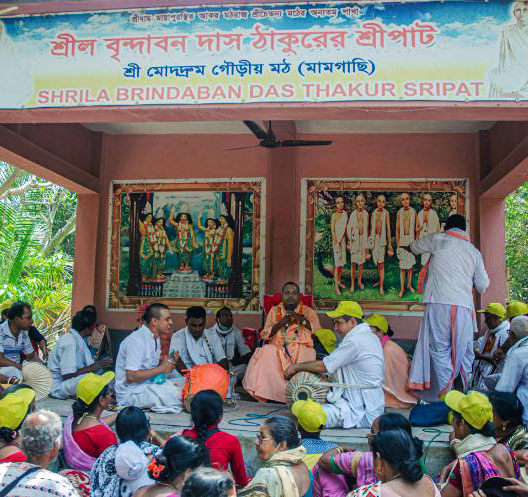
(At the holy birthplace of Srila Vrindavan Das Thakur.)
— • • • —
|
|
Sitemap | Contact us | About us