
Our Disciplic Succession:


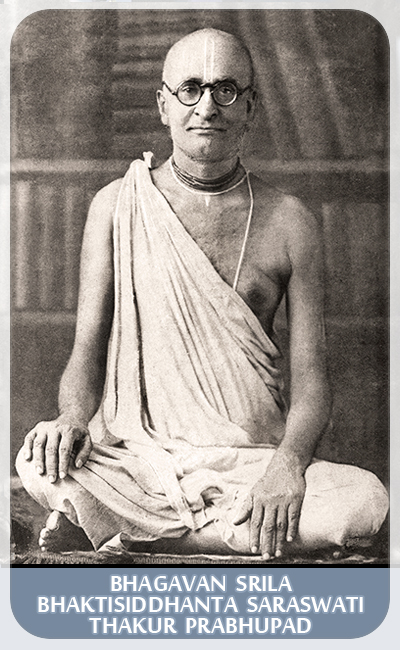
|
"The Sun Never Sets on Sri Chaitanya Saraswat Math":
|
| ABOUT US | GUIDANCE | LIBRARY | DAILY PRACTICE | PHOTO | CALENDAR | CONTACT | বাংলা |
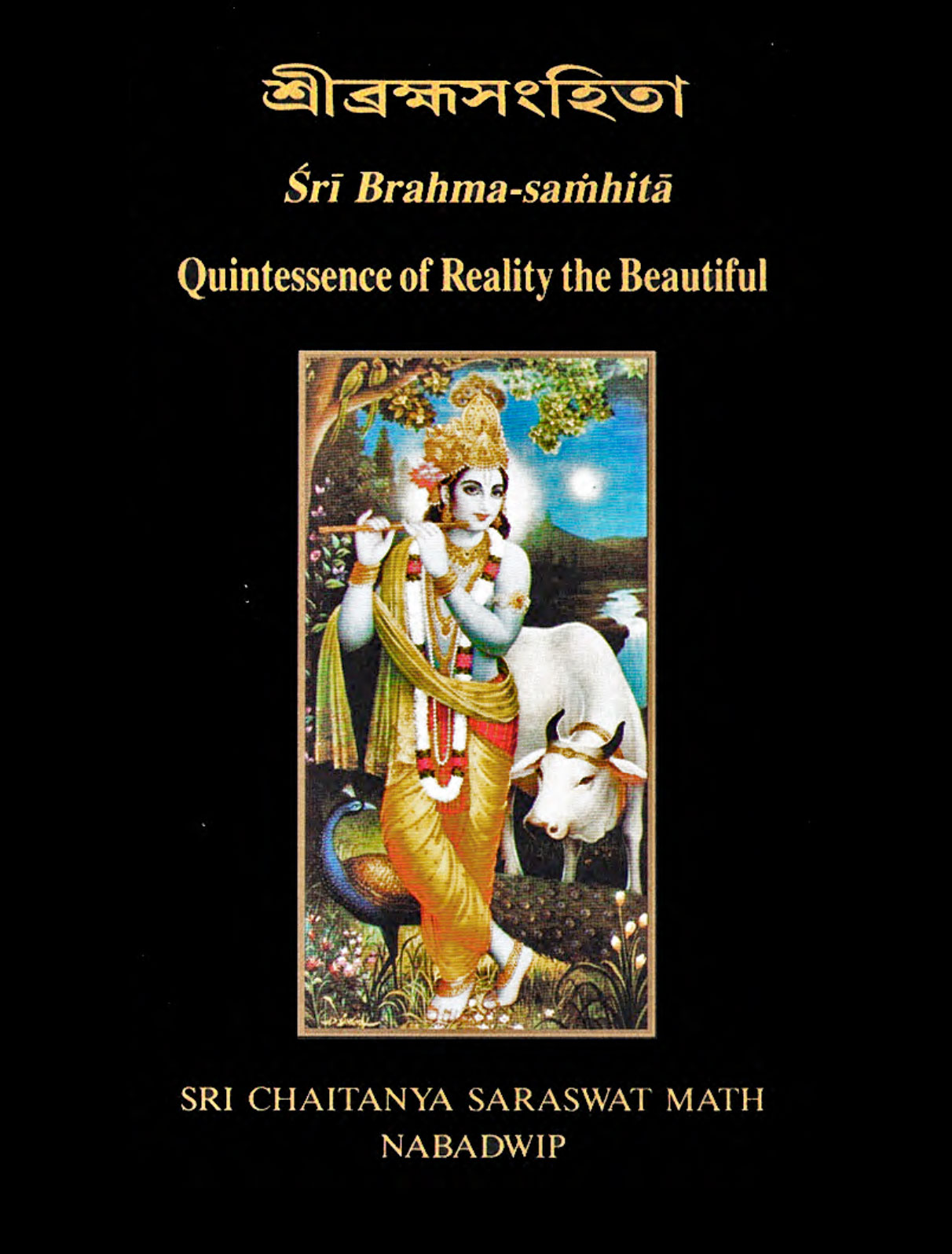
SRI BRAHMA-SAMHITA
Verse 21
sa nityo nitya-sambandhah prakrtis cha paraiva sa [21]
Translation: The jiva is eternal, and has an eternal relationship with the Lord for beginningless and endless time; he is of the superior, or transcendental, energy.
Purport: As there is a perpetual relationship between the sun and its rays of effulgence, the Supreme Lord and the jivas similarly have an eternal relationship. The jivas are atomic particles of His rays of consciousness or divine potency, and thus they are not temporary like any mundane substance. Being particles of the rays of His effulgence, they have inherited a minute proportion of Krishna’s qualities; therefore, the jiva is an embodiment of perception, the perceiver, egoism, the enjoyer, the thinker and the doer. The mutual distinction between Krishna and the jiva is that Krishna is almighty while the jiva is atomic. Their eternal relationship is that the jiva is the eternal servitor of the Supreme Lord, and the Lord is his eternal master. The jiva is also endowed with ample eligibility in respect to rasa, or a divine ecstatic relationship with the Lord.
The statement of Sri Gita apareyam itas tv anyam prakrtim vidhi me param informs us that the jivas are of Krishna’s superior or transcendental energy; all the qualities of the pure soul are transcendental to the eight material qualities of ego, etc. Therefore, the jiva potency, despite the minuteness of its magnitude, is constitutionally superior to illusion, or maya.
Another name of the jiva potency is tatastha-sakti, or ‘marginal potency,’ being that he is located on the line of demarcation between the plane of Maya and divinity; due to his minuteness he is prone to be captivated by illusion, but when he remains submissive to Krishna, the Master of Maya, he is no longer susceptible to the thralldom of Maya. The conditioned soul who is captivated by Maya since time immemorial must undergo worldly tribulation and sorrow, and be reborn again and again.
•
For Reader's Appreciation
•
Feelings of Appreciation
•
Prologue
•
Translator's Note
•
Illumination
•
Verse 1
•
Verse 2
•
Verse 3
•
Verse 4
•
Verse 5
•
Verse 6
•
Verse 7
•
Verse 8
•
Verse 9
•
Verse 11
•
Verse 12
•
Verse 13
•
Verse 14
•
Verse 15
•
Verse 16
•
Verse 17
•
Verse 18
•
Verse 19
•
Verse 20
•
Verse 21
•
Verse 22
•
Verse 23
•
Verse 24
•
Verse 25
•
Verse 26
•
Verse 27
•
Verse 28
•
Verse 29
•
Verse 30
•
Verse 31
•
Verse 32
•
Verse 33
•
Verse 34
•
Verse 35
•
Verse 36
•
Verse 37
•
Verse 38
•
Verse 39
•
Verse 40
•
Verse 41
•
Verse 42
•
Verse 43
•
Verse 44
•
Verse 45
•
Verse 46
•
Verse 47
•
Verse 48
•
Verse 49
•
Verse 50
•
Verse 51
•
Verse 52
•
Verse 53
•
Verse 54
•
Verse 55
•
Verse 56
•
Verse 57
•
Verse 58
•
Verse 59
•
Verse 60
•
Verse 61
•
Verse 62
•
Verse Contents
Download (epub)
Download (pdf)
Sitemap | Contact us | About us