
Our Disciplic Succession:


|
"The Sun Never Sets on Sri Chaitanya Saraswat Math":
|
| ABOUT US | GUIDANCE | LIBRARY | DAILY PRACTICE | PHOTO | CALENDAR | CONTACT | বাংলা |
SRI BRAHMA-SAMHITA
Verse 27
atha venu-ninadasya trayi-murtimayi gatih
sphuranti pravivesasu mukhabjani svayambhuvah
gayatrim gayatas tasmad adhigatya sarojajah
samskrtas chadiguruna dvijatam agamat tatah [27]
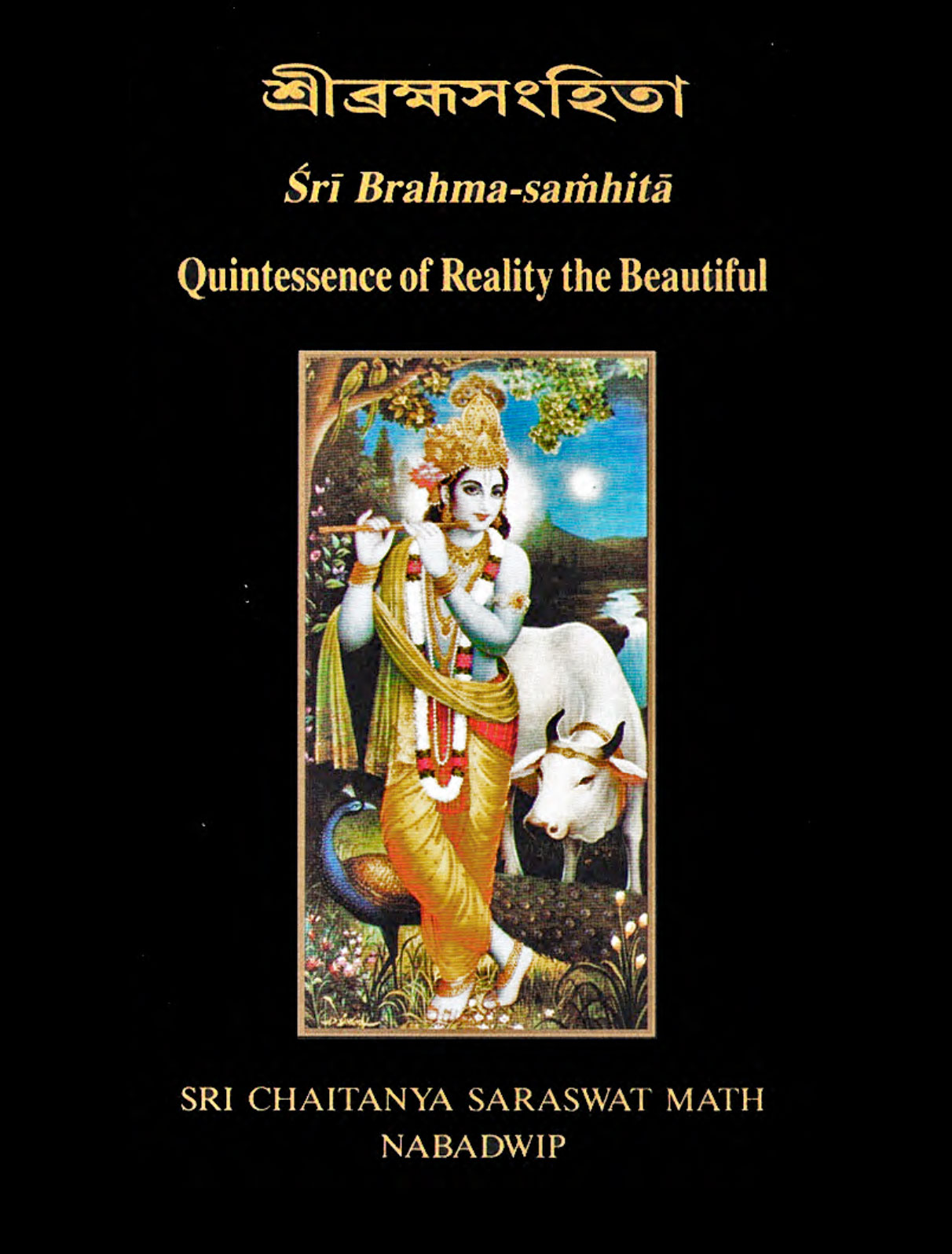
Translation: Thereafter, the gayatri of threefold form, that is, of the form of Omkara (a-u-m), emanated as the beautiful harmonious sequence of the song of Sri Krishna’s flute. Entering the ears of Brahma, it was swiftly manifest within his lotus mouth. Thus Brahma, who was born of the lotus flower, received gayatri as it emanated from the divine flute-song of Sri Krishna, and so he was initiated by the Supreme Lord, the original guru, and elevated to the status of twice-born (dvija).
Purport: The divine vibration of Krishna’s flute is a sound of truth, cognizance and ecstasy (sach-chid-ananda-maya), and so the paragon of the Vedas is present within that divine sound. Gayatri is a Vedic metre embracing both meditation and prayer in a compact form. Furthermore, the kama-gayatri is topmost since the prayer and meditation contained within it are of the nature of full-fledged divine pastimes in a manner not found in any other gayatri.
The kama-gayatri, which is the gayatri taken after the eighteen-syllabled mantra, is klim kamadevaya vidmahe puspabanaya dhimahi tanno ‘nangah prachodayat. In this gayatri is indicated the realization of the lila, or divine pastimes, of Sri Gopijanavallabha, the beloved of the gopis, after complete meditation upon Him; and the prayer to attain to (the service of) that transcendental cupid. In the entire transcendental world there is no higher pursuit for divine love in the shelter of an ecstatic relationship with Him.
As soon as that gayatri entered into the ears of Lord Brahma, he attained the purificatory initiation into the status of the twice-born, or dvija, and he began to sing the gayatri.
Any jiva who has properly received this gayatri has attained to divine rebirth. This rebirth is entrance into the transcendental plane, something infinitely superior to the status of the initiation or second birth of the materially conditioned souls that is given according to their nature or lineage in the material world. By divine initiation, the rebirth that is the attainment of divine birth, one reaches the spiritual world—the ultimate glory of the jiva.
•
For Reader's Appreciation
•
Feelings of Appreciation
•
Prologue
•
Translator's Note
•
Illumination
•
Verse 1
•
Verse 2
•
Verse 3
•
Verse 4
•
Verse 5
•
Verse 6
•
Verse 7
•
Verse 8
•
Verse 9
•
Verse 11
•
Verse 12
•
Verse 13
•
Verse 14
•
Verse 15
•
Verse 16
•
Verse 17
•
Verse 18
•
Verse 19
•
Verse 20
•
Verse 21
•
Verse 22
•
Verse 23
•
Verse 24
•
Verse 25
•
Verse 26
•
Verse 27
•
Verse 28
•
Verse 29
•
Verse 30
•
Verse 31
•
Verse 32
•
Verse 33
•
Verse 34
•
Verse 35
•
Verse 36
•
Verse 37
•
Verse 38
•
Verse 39
•
Verse 40
•
Verse 41
•
Verse 42
•
Verse 43
•
Verse 44
•
Verse 45
•
Verse 46
•
Verse 47
•
Verse 48
•
Verse 49
•
Verse 50
•
Verse 51
•
Verse 52
•
Verse 53
•
Verse 54
•
Verse 55
•
Verse 56
•
Verse 57
•
Verse 58
•
Verse 59
•
Verse 60
•
Verse 61
•
Verse 62
•
Verse Contents
Download (epub)
Download (pdf)
Sitemap | Contact us | About us