
Our Disciplic Succession: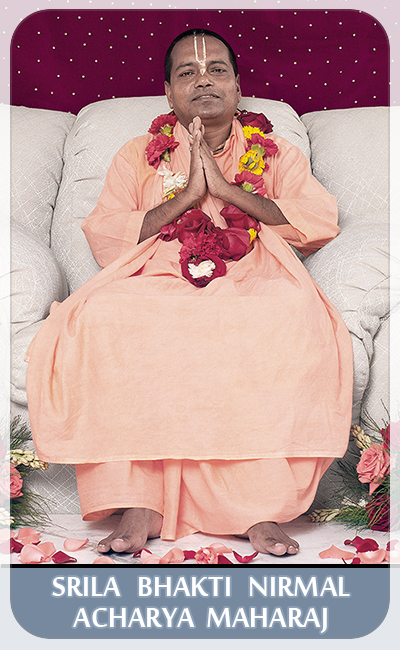


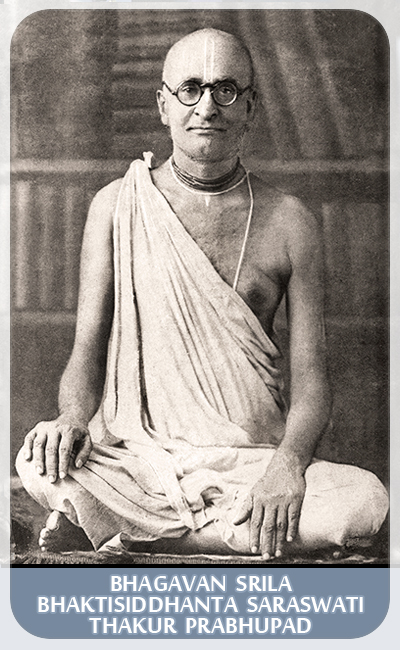
|
"The Sun Never Sets on Sri Chaitanya Saraswat Math":
|
| ABOUT US | GUIDANCE | LIBRARY | DAILY PRACTICE | PHOTO | CALENDAR | CONTACT | বাংলা |
SRI BRAHMA-SAMHITA
Verse 8
niyatih sa rama-devi tat-priya tad-vasam tada
tal-lingam bhagavan sambhur jyotirupah sanatanah
ya yonih sapara saktih kama-bijah mahadd-hareh [8]
Translation: (That indirect association with Maya is being described.) The personification of the transcendental potency of the Lord, Ramadevi, is Destiny, beloved consort of the Supreme Lord. At creation, the appearance of the effulgence of the portion of Krishna’s plenary portion is Bhagavan Sambhu, the manifest male organ of the divinity—the reflection of the eternal effulgence. Subject to the potency of Destiny, that male symbol is the portion of the Absolute responsible for the generation of the material world. The reproductive potency that evolves from Destiny appears as the female organ, the embodiment of Maya, the inferior potency. The union of these organs brings forth the existence of the mahat-tattva, which is only a reflection of the Supreme Lord Hari’s original seed of desire (kama-bija).
Purport: Being endowed with the creative desire, the plenary expansion of Krishna, Sankarsan, takes the initiative in bringing about the creation of the mundane world. Taking the form of the first predominative descent (purusavatara), He reclines on the causal waters and casts a glance at Maya.
That glance is instrumental in the cause of the creation. The twilight image of that reflected effulgence of the Almighty is effectively the organ of generation, Sambhu, which unites with the reproductive paraphernalia of Maya, the shadow of the Rama potency. Then, the reflection of the original seed of desire, kama-bija, emerges as the mahat-tattva, the great or universal seminal principle, and engages in the creative function. The initial manifestation of the desire created by Maha-Vishnu is known as hiranmaya mahat-tattva; it is the mental principle of readiness for universal creation.
The inner conception here is that assuming both the instrumental and efficient causes (nimitta-upadana), the will of the predominator, or purusa, creates. The instrumental cause is personified as Maya, who represents the female reproductive organ; the efficient cause is personified as Sambhu, who represents the male generative organ; and Maha-Vishnu is the predominator, or the inaugurator by His will.
The primordial ingredients, or substance (pradhana), are efficient, while the female receptacle principle (prakrti) is Maya; and the willing factor that unites them is the manifestor of the illusory mundane world, the predominator (purusa), who is a plenary expansion of Krishna. These three form the agency of universal creation.
The original seed of desire, kama-bija, that exists in Goloka, is pure transcendental cognition, and the seed of desire that exists in the material world is a manifestation of the shadow potency personified as Kali and other forms. Despite being the prototype of Maya, the original seed of desire is infinitely distant from Maya; the mundane seed of desire is an illusory reflection. The process of Sambhu’s birth is described in verses ten and fifteen.
•
For Reader's Appreciation
•
Feelings of Appreciation
•
Prologue
•
Translator's Note
•
Illumination
•
Verse 1
•
Verse 2
•
Verse 3
•
Verse 4
•
Verse 5
•
Verse 6
•
Verse 7
•
Verse 8
•
Verse 9
•
Verse 11
•
Verse 12
•
Verse 13
•
Verse 14
•
Verse 15
•
Verse 16
•
Verse 17
•
Verse 18
•
Verse 19
•
Verse 20
•
Verse 21
•
Verse 22
•
Verse 23
•
Verse 24
•
Verse 25
•
Verse 26
•
Verse 27
•
Verse 28
•
Verse 29
•
Verse 30
•
Verse 31
•
Verse 32
•
Verse 33
•
Verse 34
•
Verse 35
•
Verse 36
•
Verse 37
•
Verse 38
•
Verse 39
•
Verse 40
•
Verse 41
•
Verse 42
•
Verse 43
•
Verse 44
•
Verse 45
•
Verse 46
•
Verse 47
•
Verse 48
•
Verse 49
•
Verse 50
•
Verse 51
•
Verse 52
•
Verse 53
•
Verse 54
•
Verse 55
•
Verse 56
•
Verse 57
•
Verse 58
•
Verse 59
•
Verse 60
•
Verse 61
•
Verse 62
•
Verse Contents
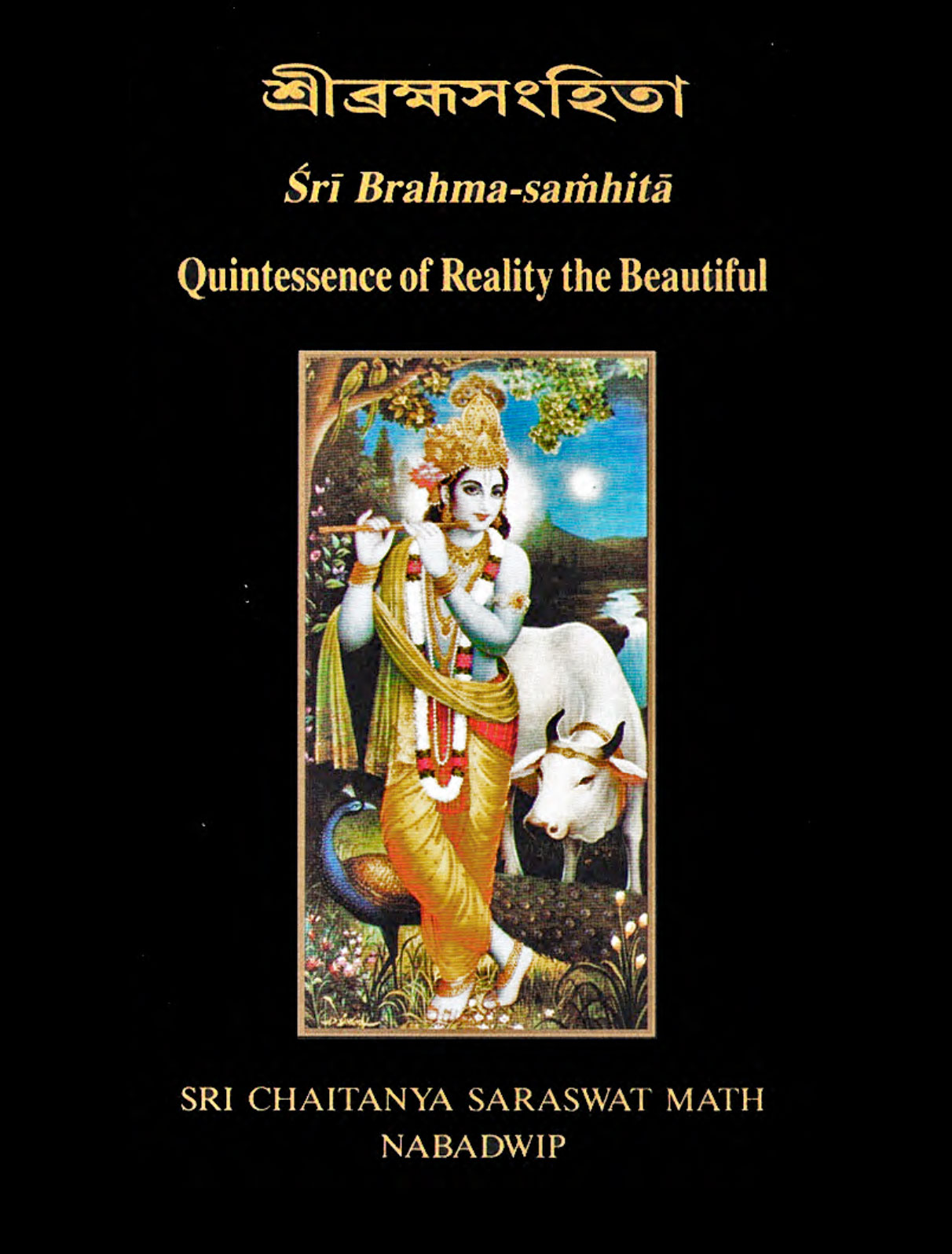
Download (epub)
Download (pdf)
Sitemap | Contact us | About us