
Our Disciplic Succession: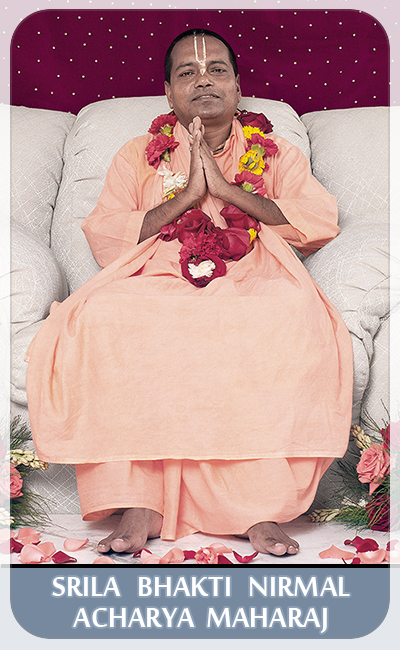


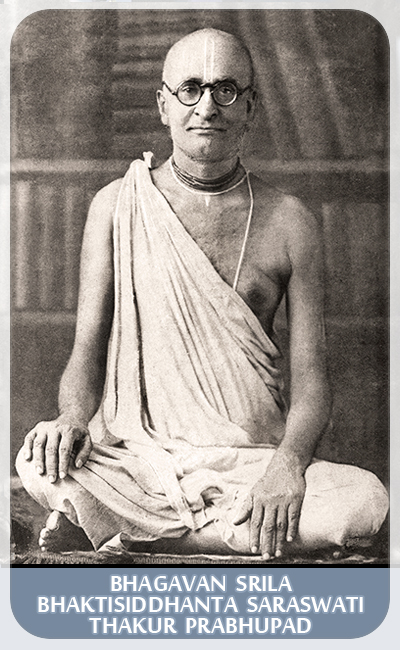
|
"The Sun Never Sets on Sri Chaitanya Saraswat Math":
|
| ABOUT US | GUIDANCE | LIBRARY | DAILY PRACTICE | PHOTO | CALENDAR | CONTACT | বাংলা |
SRI BRAHMA-SAMHITA
Verse 26
atha tepe sa suchiram prinan govindam avyayam
svetadvipa-patim krsnam goloka-stham paratparam
prakrtya guna-rupinya rupinya paryupasitam
sahasra-dala-sampanne koti-kinjalka-brmhite
bhumis chintamanis tatra karnikare mahasane
samasinam chidanandam jyotirupam sanatanam
sabda-brahmamayam venum vadayantam mukhambuje
vilasiniganavrtam svaih svair amsair abhistutam [26]
Translation: Desiring to attain the grace of Govinda, Brahma took up practising long penance for the pleasure of that Lord of Svetadvipa, who is none other than Krishna in Goloka. Brahma’s meditation followed in this line: in the land made of wish-fulfilling gems is a thousand-petalled lotus flower that blooms with millions of stamens.
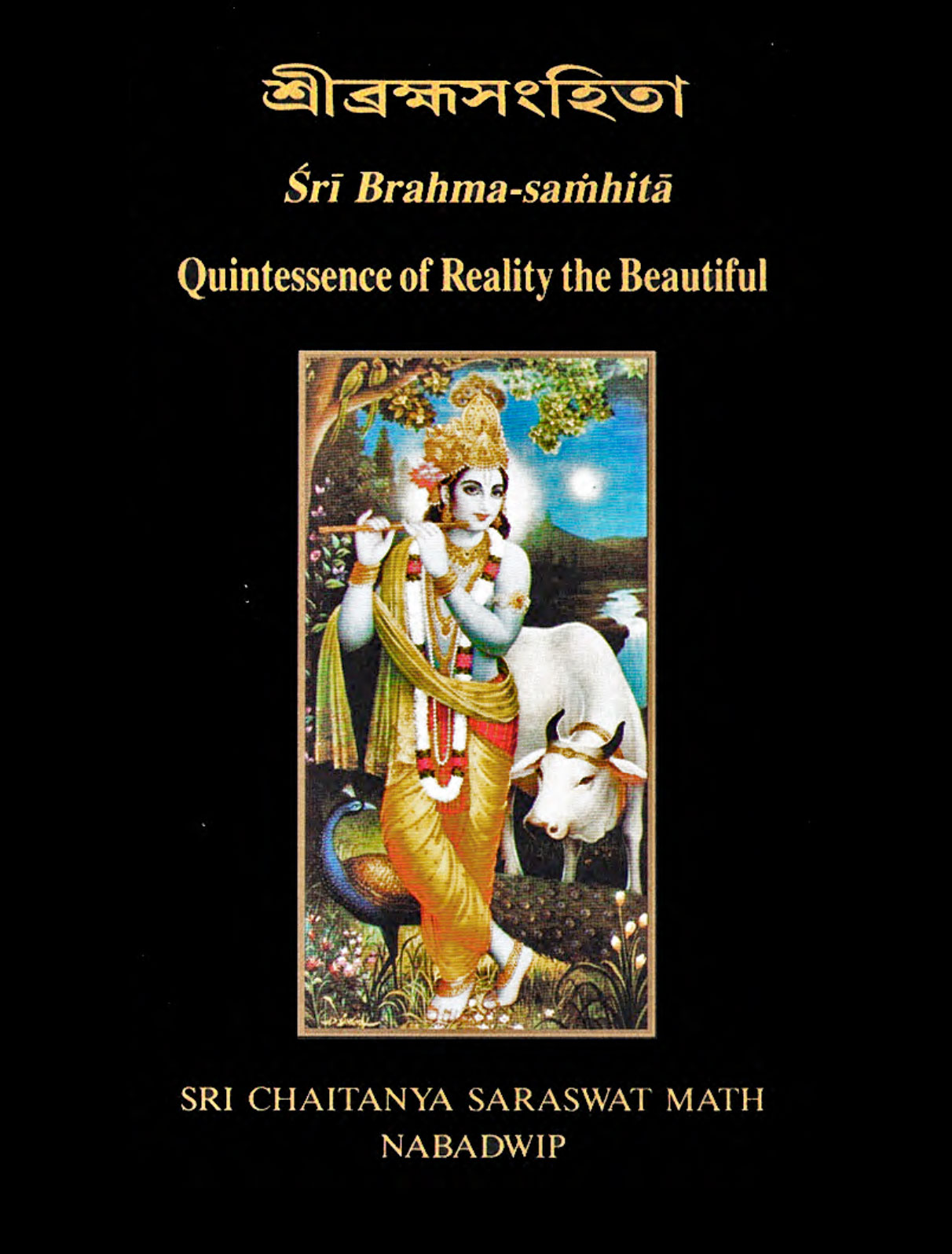
In the centre of the lotus there is a grand throne, upon which eternal Sri Krishna, the embodiment of the effulgence of divine loving ecstasy, is seated. On His lotus lips the flute of transcendental sound is vibrating sonorously, and His glories are sung by the gopis of His pastimes (who surround Him), along with the gopis’ associates who are their respective personal expansions.
As the supreme worshippable object, He is worshipped (from outside) by prakrti (Maya), who is the embodiment of material qualities (gunas).
Purport: Maya’s nature is materially active (rajasik), and she assumes the forms of Durga, etc., embodying the qualities of material truth, activation and inertia (sattva-, raja- and tamo-guna); however, the object of her meditation is completely transcendental; thus Maya—the embodiment of the inferior potency—meditates upon Krishna with a reverential or worshipful attitude.
Whoever has material hankering in the heart should worship Mayadevi’s object of worship. Even without worshipping Mayadevi, they will attain success by worshipping Mayadevi’s object of worship. The purport of the Srimad Bhagavatam verse akamah sarva-kamo va moksa-kama udaradhih, tivrena bhaktiyogena yajeta purusam param is that although the various demigods, as expansions of the power of the Supreme Lord, are the bestowers of certain rewards, an intelligent person nonetheless worships with resolute devotion the Supreme Godhead, who is replete with the potency to bestow all fruits.
Thus Brahma meditated upon Mayadevi’s reverentially worshipful truth, Krishna, the Supreme Enjoyer of His pastimes in Goloka. Pure devotion that is free from all kinds of fleeting desires is niskama-bhakti, or devotion devoid of vested interest or selfishness; the devotion of Brahma and personalities of his general calibre is sakama, or possessing some personal interest. Still, even within such devotion with vested interest there is a selfless stage, and this will be elucidated in the last five verses of this holy book. As long as one has not attained to svarupa-siddhi, or perfection in one’s divine self, the method given herein is the convenient way of rendering devotional service for the fallen conditioned soul.
•
For Reader's Appreciation
•
Feelings of Appreciation
•
Prologue
•
Translator's Note
•
Illumination
•
Verse 1
•
Verse 2
•
Verse 3
•
Verse 4
•
Verse 5
•
Verse 6
•
Verse 7
•
Verse 8
•
Verse 9
•
Verse 11
•
Verse 12
•
Verse 13
•
Verse 14
•
Verse 15
•
Verse 16
•
Verse 17
•
Verse 18
•
Verse 19
•
Verse 20
•
Verse 21
•
Verse 22
•
Verse 23
•
Verse 24
•
Verse 25
•
Verse 26
•
Verse 27
•
Verse 28
•
Verse 29
•
Verse 30
•
Verse 31
•
Verse 32
•
Verse 33
•
Verse 34
•
Verse 35
•
Verse 36
•
Verse 37
•
Verse 38
•
Verse 39
•
Verse 40
•
Verse 41
•
Verse 42
•
Verse 43
•
Verse 44
•
Verse 45
•
Verse 46
•
Verse 47
•
Verse 48
•
Verse 49
•
Verse 50
•
Verse 51
•
Verse 52
•
Verse 53
•
Verse 54
•
Verse 55
•
Verse 56
•
Verse 57
•
Verse 58
•
Verse 59
•
Verse 60
•
Verse 61
•
Verse 62
•
Verse Contents
Download (epub)
Download (pdf)
Sitemap | Contact us | About us